

Report: Evil of the Daleks BFI London Southbank Special Event
As you approach the BFI London Southbank cinema its signage declares “Dream Palace “and I completely understand why. There is something very special about the BFI and the complete love the staff have for film in general and specifically Doctor Who.
As the hosts Justin Johnson (Lead Programmer for BFI) and Dick Fiddy (BFI Archive Television Programmer) spring onto the stage you know there will be nothing better than spending a few pleasurable hours enclosed with them and other like-minded fans. The newest release in animation, the 1967 story “Evil of the Daleks” got its premiere on the 12th September. With my precious ticket in my hand, I poured in with other fans to a full screening of a lost story where only one live episode ( 2) exists in the BBC archives.
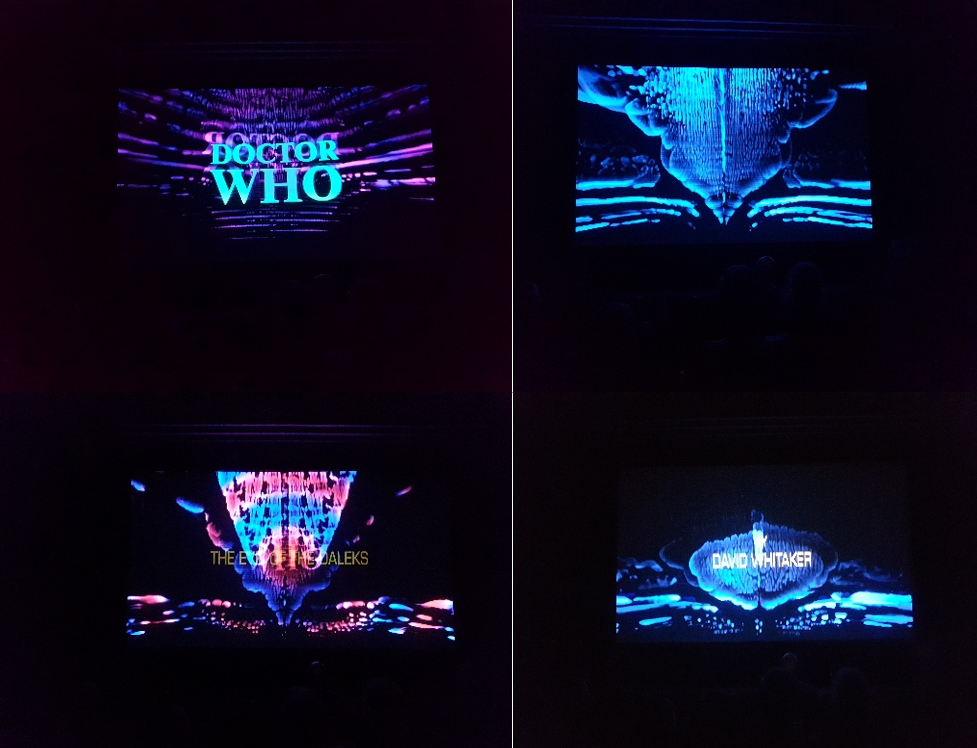
Roger Bunce
As with previous screenings of the longer stories, the format of the day was four episodes shown in colour, then a guest, the three final episodes and more guests to conclude. The premiere was dedicated to the memory of camera operator Roger Bunce who died on the 29th August and who specialised in special effects camera work. Dick Fiddy gave some background on how he joined the BBC in an influx of new technicians when BBC2 launched in 1964. His family were guests in the BFI audience. Roger experimented with a black and white luminous overlay on “Evil of the Daleks” a forerunner of “Colour Separation Overlay” which Roger pioneered in the 1970s on Doctor Who.
He was very much an experimenter and enjoyed and embraced the energy of Doctor Who. Roger was an active union rep and whilst he may have disagreed with certain decisions always supported and was loyal to the BBC corporation.

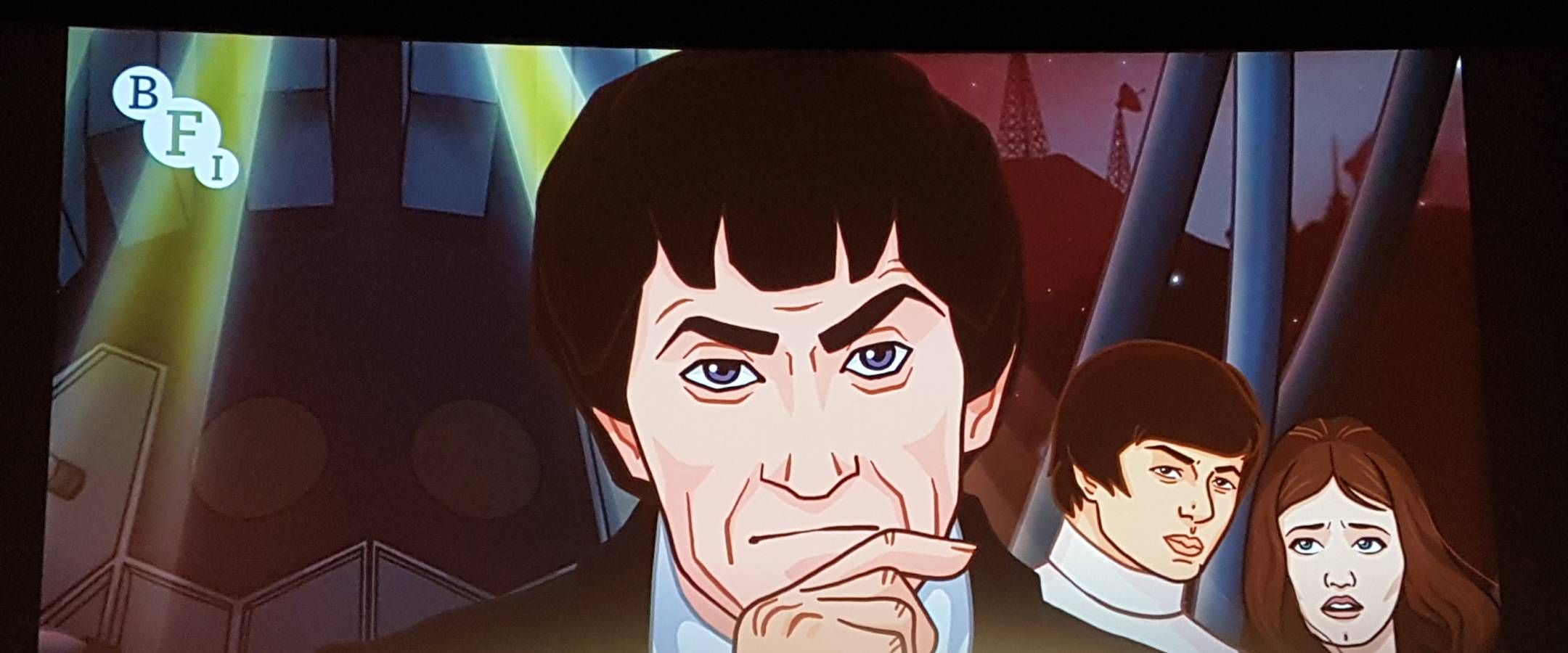
The animation for Evil of the Daleks
The fourth season of classic Doctor Who is shaping up very nicely now with all stories, bar “The Highlanders” available in some kind of live visual format. This story picks up straight on from “The Faceless Ones “also available in an animation version made by the same team. What is really interesting is the look of “Evil” is an improvement from the Scooby Doo look as I call it, of “The Faceless Ones”. There is a mix of hand-drawn 2D characters combined with 3D Dalek figures and scenery which noticeably enhances the story and creates a visually superior product.
As the episodes are available in colour or black and white format there is a choice of how you want to view them. The creative team at BBC Studios behind “Evil of the Daleks” disclosed, during their interview, that as there isn’t much actual live footage to compare to, for 6 out of 7 episodes, they used the opportunity of animation to reimagine how scenes could be shot. The animations project aim isn’t to create a frame by frame reconstruction of the live-action 1960’s episode ( which isn’t possible or desirable) but the 3D aspect definitely works.
“You very kindly commented about the quality of this version and I think this is a big step up from the last one that we did.”
Anne Marie Walsh, Animation director at BBC Studios
Thinking of individual best bits for me is a sweeping shot of the Maxtible mansion near the beginning of the story showing the full grandeur of the outside house and moving through the main entrance. Also, later when the thug Kennedy is ransacking the safe at the shop as part of the cliff-hanger there is a change of shot over his shoulder with a Dalek stealthily pointing at him in the background. The final episode also has the climax showing a glorious colour palette of the destruction of the Dalek city. It was created by Rob Ritchie, one of the animators from BBC Studios.
What is highlighted is the use of modern technology working in a different medium to reimagine what would have been originally created with models including toys. So there are sweeping shots and shots from above and as a sequence, I found it particularly stunning. Most of the BFI audience also seemed to appreciate the ending if the strong applause is anything to go by.
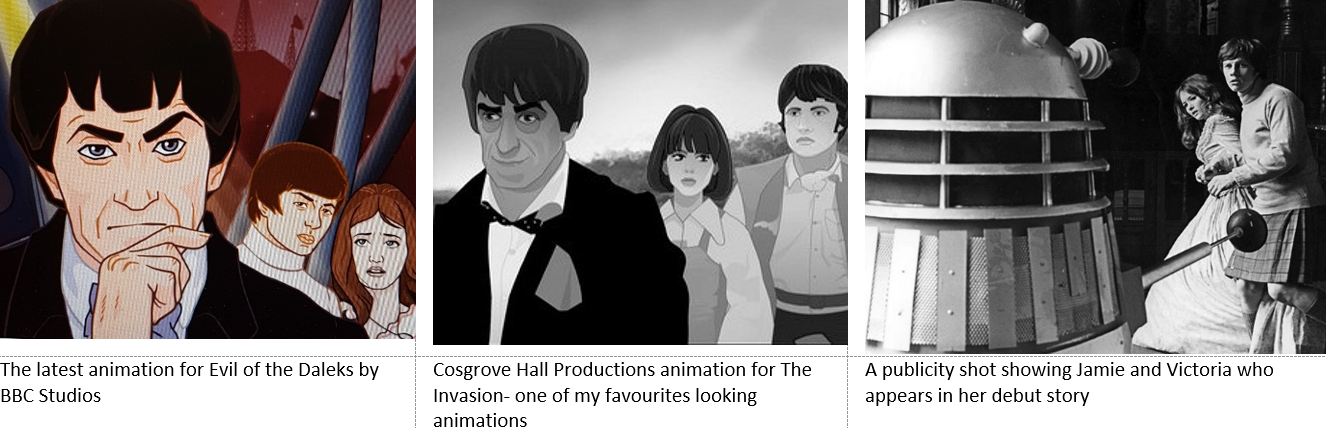
If there is a niggle and it’s a personal taste for me around the drawing of some of the main characters especially faces. I’ve always thought “The Invasion” had some of the best character animations which were done by Cosgrove Hall Productions seamlessly fitting in with the live-action episodes. The BBC Studios team get the broad likeness of Jamie, and the 2nd Doctor’s face with some reworking that they’ve done. Whereas I am forgiving of other artistic leaps of imagination used for the stories it feels an important part of the aesthetic atmosphere of animations.
Saying that I still miss the subtlety of live-action of Patrick Troughton’s expression reacting moment by moment though. The facial drawing of Victoria though doesn’t for me quite encapsulate Deborah Watling’s doe-eyed beauty and it was really noticeable, for me, through the screening.
Mark Ayres interview
What makes this story really enjoyable is three elements successfully come together: The pace of the animation melds to an absorbing story and a superb soundtrack playing at the BFI. Firstly the orchestral soundtrack by in house composer Dudley Simpson really gives a cinematic vibe to the action. Mark Ayres who is a familiar collaborator with audio remastering when the BBC are releasing new Blu-ray sets and DVDs was interviewed by Dick Fiddy.
Mark told how privileged he feels to work on these classic Doctor Who stories. He revealed the soundtrack was taken from off-air recordings made by fan Graham Strong as well as the existing film track. Mark had to do a lot of work improving the sound mix, so bringing the noise floor down and restoring the original frequencies.
The “Dalek March” is heard at a higher frequency so feels enhanced. He revealed due to a scene in episode 1 with a jukebox playing real music how he had to create ten versions of the episode because of copyright issues. It meant removing or keeping band music from the Beatles, Dave Dee Dozy Beaky Mick & Tich and creating different country versions for the UK, US and the rest of the world as well as narrated, tele-snaps versions too.


One of the questions asked by Justin Johnson in jest at the beginning of this event to the audience was if Evil of the Daleks” is worth it? “The story came in at number 34 out of 241 stories in the 2014 Doctor Who Magazine The First 50 Years survey. I listened to the audio a few years ago and David Whittaker is one of my favourite writers of the 1960s. I think it deserves its reputation as a classic. David Whittaker has the knack of making the Daleks interesting when they interact with humans.
In this, his second Dalek story, they have evolved further from the cunning creatures of “Power of the Daleks” to use brute force to understand their enemies. I really enjoy the 1960’s modern-day vibe of the 1st episode as it develops Jamie and the Doctor’s partnership. The Daleks have probably been tracking the Doctor when he was in 1966 for “The Faceless Ones” and lay a trap.
Taking the Doctor and Jamie backwards in time to the Victorian era of 1866 where their plan is revealed. At seven episodes “ Evil” is possibly one episode too long but nevertheless, David Whitaker weaves such an interesting story to involve the Doctor and Jamie that the viewing wasn’t a huge effort to get through. There are bad characters and coerced characters forced into actions they wouldn’t ordinarily do that is interesting to see how cunning the 2nd Doctor has to be to defeat his enemies. I like how Jamie and the Doctor’s relationship is tested.
Conversing how the screening was Mark’s first opportunity in a long time to watch “Evil of the Daleks” in its entirety he mentioned how the engrossing story was “strong stuff “Without giving away too much of the plot Victoria’s father Edward Waterfield is seen as struggling after the death of a man. Mark noted Doctor Who may have been aimed at children but it didn’t shy away from moral consequences.
Interview with BBC Studios animation team
Anne Marie Walsh, the animation director, from BBC Studios, came to the stage after the screening finished along with colleagues Thomas Bland and Barry Baker responsible for the hand-drawn 2D animation. Thomas Bland was mainly a character animator and Barry Baker was one of four storyboard creators responsible for Maxtible’s laboratory as well as character turnaround and subtle reworkings of Patrick Troughton’s and Frazer Hines’s characters head tilts.
Explaining the process of working, the teamwork mainly from the audio and camera script and use tele-snaps or photographs so they get a very good idea of how things were originally shot but want to add their own touches.
There was some editing of the”Evil” audio to reduce “dead space” where real-life actors might be standing around. Barry was aware of the 1960’s style of long-held shots of characters responding, maybe nodding and cut it all out when storyboarding. Other 1960’s style shots were close up tight shots of faces which they kept to.
All of the team were appreciative of classic Who giving stories of how familiar they were (or not) with Doctor Who prior to the commissioning of the animations. Justin Johnson quizzed them about the process of commissioning a story and Anne Marie revealed it starts with having a good soundtrack and then follows a conversation about stories they are looking at. Some stories, due to large casts or many locations would probably be vetoed doing due to the tight time turnaround required.
The aim is always to create a quality product and push standards of animation so they would not want to commit to a project if they couldn’t do good storyboards, better animation and production values.
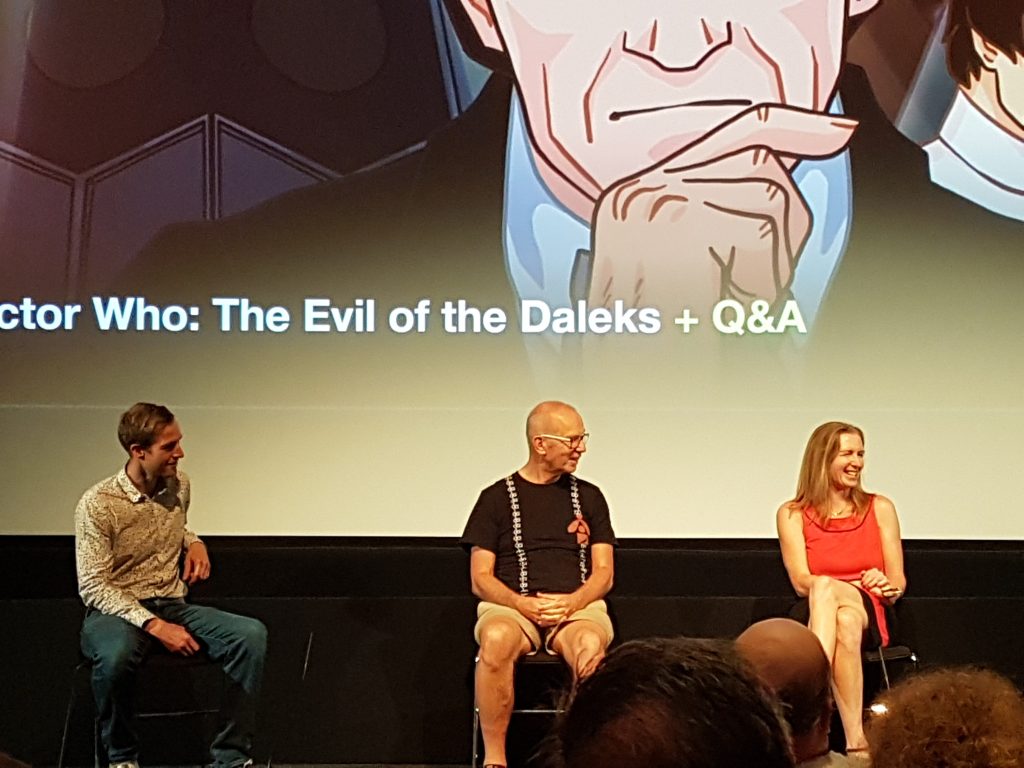
Anne Marie does push for more time for these projects and acknowledged the real appreciation from the BFI audience for this animation. She felt it was rewarding and fantastic to hear people laugh at bits they had forgotten were funny. The improvement was due mainly to being allowed more time namely 18 months for this project which makes a massive difference as the team could plan more breakdown drawings of characters such as front and side face views, subtle head, facial, eye, nose feature movements creating a more layered result.
There were in total ten animators working for a year including during lockdown after some months of pre-production, The colour palette for the location of Maxtible’s house was researched and planned from photos of Grim’s Dyke Hotel, as well as research of the various films made there.
Justin Johnson did ask if there was a story they would want to do but felt they would need more time due to the complexity of the project but Anne Marie politely declined to be drawn on any answers in a public forum such as BFI. She did say they are trying to fill gaps and complete certain seasons but the decision isn’t hers as it’s decided from a business perspective with what can be achieved within limited timescales and various other factors to consider.
The event finished with rapturous applause for all the guests. It was announced there will also be a signing of the new release at The Who Shop in London on Saturday 2nd October. Doctor Who Evil of the Daleks is released on DVD, Blu-ray and an exclusive Steel book from the 27th September. The three-disc release gives fans the opportunity to enjoy The Evil of the Daleks, available in either colour or black and white and will include a:
- Remastered Surviving Original Episode 2
- Telesnap Reconstructions – 6 episodes
- Audio Commentaries
- Audiobook, with a recorded commentary by Tom Baker
- Making Of and a Photo Gallery
Are you looking forward to the Evil of the Daleks release and if so why? Did you see the original transmission? Post your thoughts on here, the Big Blue Box Podcast Discord Server or on Twitter. Let’s talk.


Comments
No one has left a comment yet.
Be the first and get the conversation going.