

Riverside Studios Cyberman Showcase Screening with Live Q&A – Review
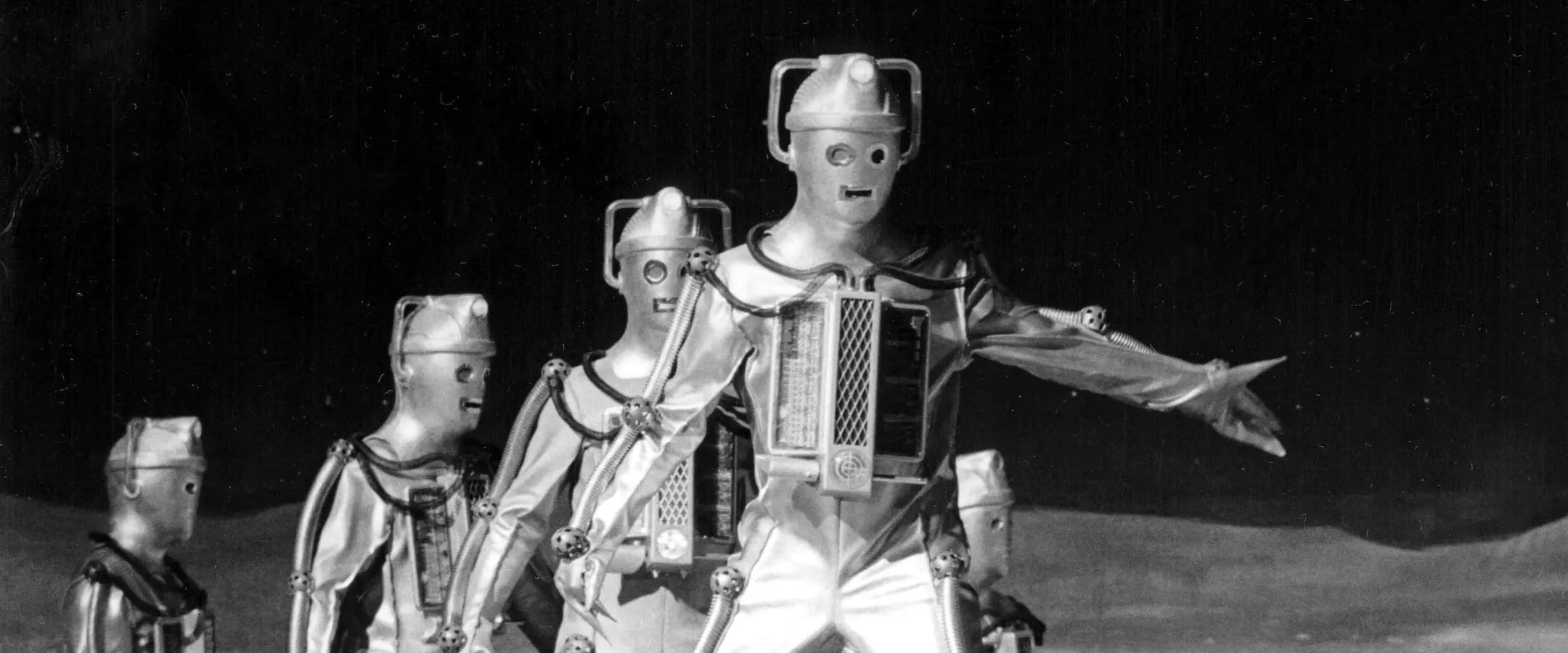
Riverside Studios in West London has a significant production history with Doctor Who. It was bought by the BBC in 1954 and between 1964 and 1968 twenty Doctor Who stories from the William Hartnell and Patrick Troughton era were filmed there. The Cybermen were a part of its tenure as a BBC filming venue. Now as an arts centre and theatre/cinema location, it seems fitting that it celebrates its past. Riverside Studios hosted a Doctor Who showcase last month, including screenings of original prints of episodes filmed at the studios that featured the popular silver creatures the Cybermen.
Two Doctor Who writers introduced the showcase, providing a brief watcher’s guide to each episode and a discussion afterwards before introducing the next. Gavin Rymill is a writer, researcher and digital illustrator who has worked for Doctor Who Magazine as a feature writer and illustrator covering the Evolution of the Cybermen. James Goss is familiar to fans as a writer of several Doctor Who books and also produced the animations of two missing episodes of “The Invasion” developed by Cosgrove Hall.
Reviewing The Tenth Planet Episode 2 (Originally transmitted 15th October 1966)
The Tardis crew have arrived at a Polar tracking station which is due to be invaded by Cybermen The idea of the Cybermen is fascinating. Replacement surgery has become commonplace for joints, but it is such an interesting idea from Dr Kit Pedlar as to what happens if you take the concept of replacement surgery to the furthest degree. It is an engrossing notion that this episode takes time to explore of losing what it is to be human by replacing all human parts and then feeling so horrified that you also remove human emotions which I assume means some lobotomy of the brain. The Cybermen’s physical impact by being tall is further heightened by the leader’s sing-song way of speaking which creates a distinct tone of difference between the Cybermen and humans. The body horror aspect of it gives me the chills but I then follow the Cyber-leader’s argument Pride, love, hate Have you no emotions Sir! and it isn’t wrong with the cold logic. It gives the episode and story a strong philosophical and political theme to explore which doesn’t continue in other stories.
Gavin Rymill shared some interesting facts about episode two: it is the last episode where William Hartnell is fully involved before he becomes too ill to work for episode three and Hartnell returns for part of episode four where the Doctor memorably regenerates but as we know there only short clips of the episode that exist.
The look of the Cybermen changes in the story as there are scenes where the Cybermen approach the base in the snow which were filmed first at Ealing Studios. It’s noted that the chest unit for the Cybermen was much larger than in the studio recording later on. As Gavin Rymill revealed they are redesigned slightly and trimmed down. Also, he highlighted that their headgear is not secure and is kept in place with Cello tape. Amazing ingenuity for what is an iconic first appearance.
What was fascinating to me and revealed by costume designer Sandra Reid in interviews was the Cybermen costumes are pink, and the body tubing is light blue. I do wonder if would they have had the same impact if seen in colour. There is something to be said about the austereness of a black-and-white film print. It matches well on an aesthetic level with the lack of colour or emotions present in the Mondasians.
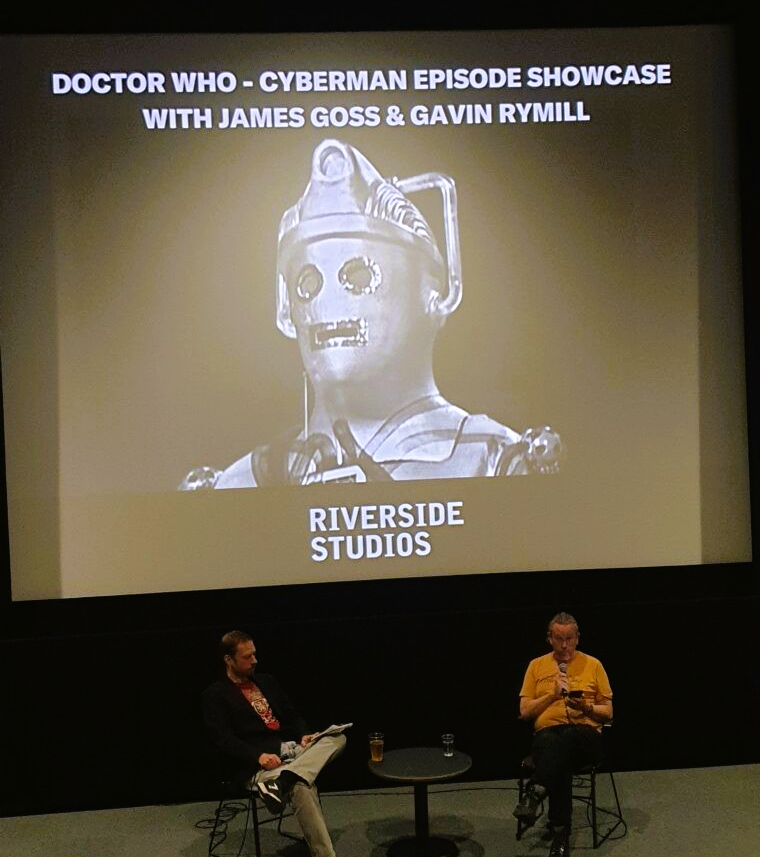
James Goss highlighted some differences in the book The Tenth Planet. In the book when Ben is in the projector room, he sees Roger Moore as James Bond. It was unclear whether it was ” The Spy Who Loved Me 1977 ” or “Man with the Golden Gun” 1974. However, in the tv serial, the film seen is “Wagon Wheels West ” from 1943. Interestingly, the book tries to engage with the premise of the story being set in 1986 whereas on television the serial does seem to hold a more contemporary tone of the sixties shown in the regimented attitudes of the soldiers and the posing pin-ups of 1950’s style glamour girls on the walls.
Gavin Rymill reflected that the idea of twin planets had been floating around in the late 1960s in both film and TV. Malcolm Hulke was commissioned to write a similar idea years before he wrote regularly for Doctor Who. Gerry Anderson’s Century 21 Productions company had made a film called “Doppelganger” or Journey to the Far Side of the Sun about a mirror image planet of Earth on the other side of the sun. In the same year as “The Tenth Planet” there was also a comic story that Skaro had floated into the solar system beside Earth and this was later used in “The Dalek Invasion of Earth” as the Daleks try to use Earth to navigate the universe.

Reviewing The Moonbase Episode 4 (Originally transmitted 4th March 1967)
In “The Moonbase” the Tardis lands on a human colonised Moon base in 2070. Both Doctor Who writers Gavin Rymill and James Goss were keen to point out the similarities between “The Tenth Planet” and “The Moonbase” in terms of the use of the base under siege scenario and having a multicultural cast. However, there are some changes. The Cyberman have been updated by Sandra Reid who was asked to make the costumes more sculpted and robotic. The chest units are the same but made from fibreglass rather than Perspex. The lamp on the headgear has become more compact not needing the thick handlebar piping to keep it in place.
One of the highlights of “The Tenth Planet ” was discovering the Cybermen had individual names Krail, Talon, Shav, Jarl and Gern which are detailed in the credits and the script. It’s the only time they are named like this as by “The Moonbase” that individuality has disappeared.
What has also changed is the singsong speaking style of the Cybermen. The voices of the Cybermen have become more robotic which is a shame really as they then become less interesting monsters. The original style used in “The Tenth Planet” had a thin vestige of humanity with the speech variation, but it reflects how fast the Cybermen have evolved within their history. The robotic voice was done using an electronic palate, used in real life with patients who have had their voice box removed which creates an electronic hum with the person using it. I must admit the robotic sound is rather grating on my ears and I do feel sorry for Peter Hawkins, who created the Cybermen voices, as using the electronic palate gave him quite a headache.

Fans of the trivial Gavin Rymill and James Goss revealed Script editor, and actor Victor Pemberton, the writer of a later serial “Fury from the Deep” is in this story without any lines and several actors are wearing the wrong name badges, due to script changes and one hides his name badge with a cheeky neckerchief!
There is a great deal of love from both writers for all of these original prints. This print of “The Moonbase” highlighted some audible production talkback heard from the studio which would normally be cleaned up for DVD releases. There is an interesting discussion to be considered as to whether these print versions should be included on Blu-ray releases as a historical record, so their idiosyncrasies aren’t lost in the future. Gavin Rymill noted after the episode screening the horizontal stripes or scan lines of the film print that were seen. The scan lines are from the video monitor being set up to transfer episodes for overseas sales and created by a film camera being pointed at a video monitor.
Reviewing The Wheel In Space Episode 6 (Originally transmitted 1st June 1968)
A pattern was emerging with the appearance of the Cybermen in the third episode of the showcase with yet another “base under siege ” story this time on a wheel-shaped space station known as W3. This story is where we meet a new companion – Zoe Herriot, an astrophysicist librarian from the far future. Gavin Rymill was humorously quick to note that Zoe makes a mistake when she and Jamie are in space as the meteoroids come towards them. She describes them as meteorites, but this is incorrect. Meteorites are pieces of rock or metal that have fallen to the earth’s surface from outer space as a meteor.
The direction by Tristan de Vere Cole for the episode impressed the writers with “frenetic moments” where there is pace with lots of quick cuts. This is then countered with long slow shots which make it interesting for a viewer to watch. Elements of the plot from this story will be borrowed for later stories such as “The Invasion”. One fact I wasn’t aware of was this story’s origins. Gavin revealed it was originally planned as a Daleks versus Cybermen story but Terry Nation wouldn’t agree to the proposal, Daleks are included when the Doctor shows Zoe some of the dangers she will face.
There is a lot of suspense, lots of slow shot and build-up :Gavin Rymill on the direction of The Wheel in Space
The third and final episode in the showcase brought an opportunity to reflect on the Cybermen. They are a rag-tag monster, a race who will do anything to survive and the episodes show an evolution in their look and speech as they become more robotised. Of the twelve Cybermen costumes in “The Moonbase” only one makes it to “The Wheel in Space”. There are new costumes on the show with what Gavin Rymill explained was “a new exoskeleton”. There are changes from the costumes of when the Cybermen are walking in space ( these are the filmed sequences) to the studio recording sessions recorded weeks later. The studio sequences debut a new wetsuit design sprayed silver which was updated in between the recording dates. The teardrop design on the eye of these Cybermen was added for ventilation.
For the Cyber-controller there is the use of the vibrating voice palette from “The Moonbase” but there are also new developments for the Cybermen voices. They are updated again and achieved using a ring voice modulator similar to what has been used for the Dalek voices. Peter Hawkins returned to voice-over the Cybermen together with Roy Skelton, who is best known for voicing the Daleks and playing Zippy and George in 1970’s children’s series Rainbow.
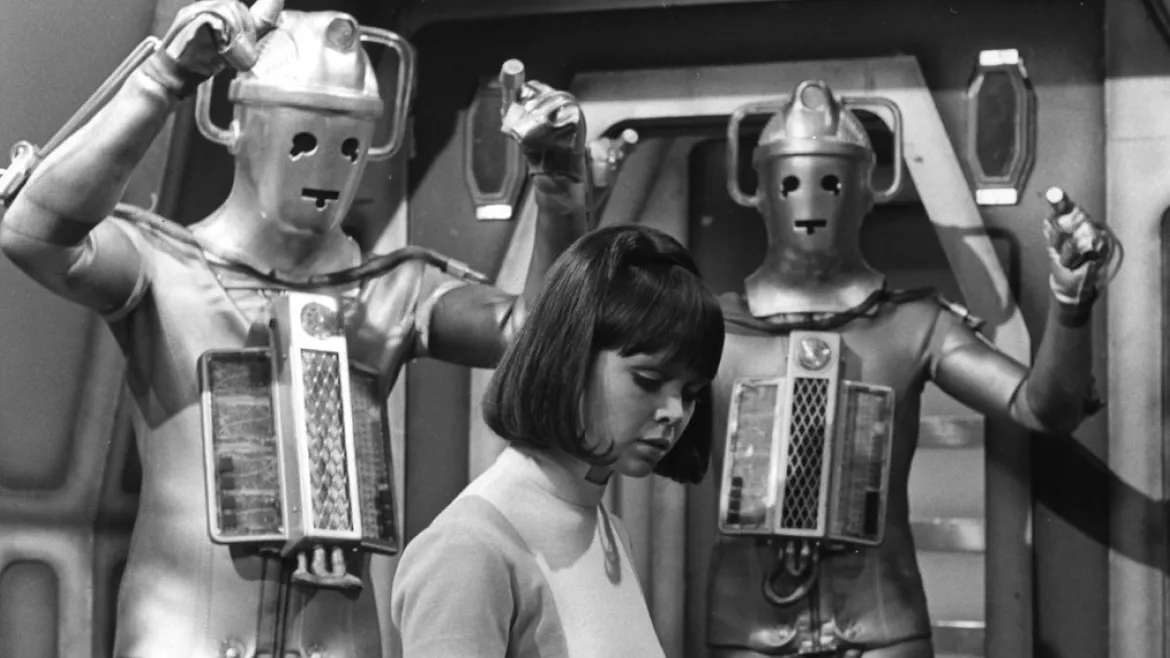
The production team are shown to be reusing props and costumes as the space station wheel was made for a production called Thirty-Minute Theatre for an episode called “The Mind-benders “. This was a British anthology drama series of short plays shown on BBC Television between 1965 and 1973, which was used in part as a training ground for new writers. The spacesuits worn by Jamie & Zoe are re-used from the astronaut’s clothing in “The Tenth Planet” and are later used in the film Star Wars: The Empire Strikes Back.
Conclusion
I loved the 1960s Cyberman showcase for the production history and all the minutiae of classic Doctor Who detail that was revealed. The Cybermen are a monster that has lived in the shadow of the Daleks an awful lot over the years but they do have a really interesting origins story. Steven Moffat exploited this detail to gloriously horrific effect in the new series with the Peter Capaldi episode World Enough and Time.
The “The Tenth Planet” is probably my favourite of the three-story episodes we saw. Thank you to RiversideLondon as these showcase events are a lot of fun to attend if you have an afternoon and two or three hours to spare, they are a relaxed opportunity to indulge in lots of facts and learn about a new disappearing but very important era of television. It certainly enriches the viewing experience of the episodes and I’ll be looking out for all the microphone booms in “The Wheel in Space“.
Riverside Studios also runs Doctor Who events in conjunction with the DWAS (Doctor Who Appreciation Society). Their next event is on the 8th of September with a classic story screening featuring the 7th Doctor, Sylvester McCoy and with special guests – Doctor Who: Projections in Time – Dragonfire + Special Guests | Riverside Studios. These events are proving very popular so you’ll need to grab tickets fast!


Comments
No one has left a comment yet.
Be the first and get the conversation going.