

Vocs, Super Vocs and the Definitive Article – The Robots of Death – 45 Years On

I was gently reminded by social media recently that it’s been forty-five years since The Robots of Death was first shown on BBC1! It sent me back cogitating to my childhood. Finding Doctor Who as a child was the beginning of a time of wonder and wanting to devour all there is to know about the time-lord. The past can be a different country. I imagine it’s the same for any Nu Who fans who were children in 2005 when the show was revived and having to realise now that was 17 years ago.
The Robots of Death has had a special place in my heart as it was one of the first VHS tapes I bought. If I was ever asked to could pick only one story of classic Who that I could take to a desert island then The Robots of Death would probably be it.
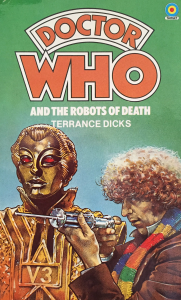
My first exposure to The Robots of Death wasn’t on tv though. The novelisation written by Terrance Dicks, first published in 1979, with its distinctive green cover with Tom Baker and a Voc was what made me read the story. Terrance’s prose is beautifully simple. The book doesn’t expand too much on what is seen in the tv serial but it made me want the VHS tape later because it was Tom Baker. Such was my fervour for reading including the Target books and poring over the stories that I borrowed all the local library stock within a few weeks. I kept The Robots of Death novelisation for far too long but the fine of a few pence seemed worth it when I couldn’t afford to buy it.
It would be 1986 before the VHS tape would come out and I eventually brought it and played it over and over. Given that stories weren’t repeated on tv the tapes became the only way to feel like you owned a part of the programme and many viewings watching the mighty Tom meant I developed a real fondness for the story.
The Robots of Death does come within the “golden era” of Doctor Who from probably one of the highest regarded teams of the Tom Baker era. Philip Hinchcliffe was a producer and Robert Homes script editor between 1975 and 1977 and together they worked on seasons 12 to 14. Philip Hinchcliffe has said in interviews that he worked on the fact that Doctor Who was made by the drama department, not the children’s department, and it was there to fill the family Saturday teatime slot.
Out of the partnership of Hinchcliffe and Holmes and their mutual interest in the darkness of gothic horror emerged a scarier more adult journey onto space. The genre of Hammer horror films and literary fictional works such as Frankenstein, The Tempest, Agatha Christie and Conan Doyle were exploited to exert a far more disturbing vision of Who than before but done with real style.
What is remarkable is that the Hinchliffe/ Holmes era creates so many memorable characters and villains using this approach. Morbius, the Krynoid, the Zygons, Sutekh, Eldrad, Li H’sen Chang, Mr Sin and Magnus Greel are frightening creations. Of course, with The Robots of Death, we also have the sand miner robots. Despite the disapproving criticism of Mary Whitehouse, who was a vocal spokesperson (of the National Viewers and Listeners Association ) against the violence of the era the viewing figures were healthy with The Robots of Death averaging 12-13 million viewers.
On a desert planet the giant sand miner crawls through the howling sandstorms, harvesting the valuable minerals in the sand. Inside, the humans relax in luxury, while most of the work is done by the robots who serve them. Then the Doctor and Leela arrive – and the mysterious deaths begin. First suspects, then hunted victims, Leela and the Doctor must find the hidden killer – or join the other victims of The Robots of Death
1979 Target Books edition
At its heart, The Robots of Death is a who-dunnit, a format I adore, but this story is far more than style over substance. Understanding the issues of poor budget classic Doctor Who had all through its run The Robots of Death with being an all-studio recording shouldn’t impress but the production design by Kenneth Sharp and costume design by Elizabeth Waller is superb. The “Art Deco” design really adds to the idea of humans wanting comfort against the sterile nature of a working ship. We see shots of the planet but the location of this “base under siege” story primarily set inside the ship perfectly suits the all studio setup. Michael E. Briant’s direction of this story is really strong.
There’s a vivid sense of claustrophobia throughout the story, much of which comes down to the way that Briant shoots this story. There are close up of the robots, also other shots from the robot’s point of view with the first death. Scenes that stand out for me are seeing when Toos is terrified by a robot, Leela finding a broken Poul which adds to the horror of the situation.
The idea of a robot society amongst us in the future is very well imagined in The Robots of Death. I really enjoy the ideas from Chris Boucher that get explored in this story. Despite the fact the robots are divided into three classes of intelligence: the D-class, “Dums” incapable of speech, the “Voc” which interacts with the humans, and the SV-class, or ”Supervoc“that is capable of reason and decision-making, they essentially beside the livery “look the same”. It’s an unsettling uniformity set against the foibles of a very human crew. Although the robots are created to be aesthetically pleasing and portrayed with calm soothing voices (an absolute stroke of genius as a concept, production-wise and inworld ) subconsciously I think it works two ways.
At this stage of this civilisation’s evolution where routine menial tasks are carried out by robots, they become unnoticeable and in some senses indispensable which lulls some of the human crew into a false sense of security. Abroad ‘Storm Mine 4’, the robots follow human orders but I love how early the idea of mistrust of robots is needed. It’s introduced from almost the first scene of the crew relaxing in a lounge as they all discuss the case of a Voc robot therapist in Kaldor City who reportedly ripped off a human client’s arm. There are still questions even in the future that their robot-assisted society is really possibly giving up to much to be at leisure.
Although this story was written in the 1970s the unease of assisted devices does resonate today. I remember reading the story of an Amazon Alexa device, granted a far more primitive device than a Voc, in the United States in 2018 that suddenly activated and said in a cheery voice, “Every time I close my eyes, all I see is people dying.” and there were issues of these devices overhearing conversations and sending private messages to external recipients.
In The Robots of Death, we are presented with varying degrees of fear shown by humans from Commander Uvanov on one side of the spectrum involved with a case of a young man in his early career with robophobia, to Poul and his later extreme reaction to the sand miner robots. Possibly one of my favourite scenes because of this development is where Poul and Leela are having a conversation about sand miner life and Poul talks about preferring living in cities with people. It’s such a human thing to want to feel a connection to other people, something a robot just cannot offer in the same way.
I am curious where the Doctor implies at one point that the situation on the sand miner could escalate and lead to a robot revolution if it spreads. We learn the company were worried enough to put an investigator and D84 onboard and I’m guessing that D84 has instruction to follow from Poul so it seems that the sand miner robots still are working within parameters directed by the humans. Of course, the irony is the disruption to the robot’s programming isn’t implemented by the robots themselves but by Taren Capel, a genius in robotics ( sorry spoilers for anyone who hasn’t seen it ) so the question would be could the robots be conscious of independent thought without direction for this to happen. I’m going down the rabbit hole on this thought but my general point is there is a lot in this reflective, intelligent script for a viewer to take and enjoy.
You know, you’re a classic example of the inverse ratio between the size of the mouth and the size of the brain
The Doctor to Borg
Season 14 in my opinion is an excellent series for Tom Baker as the dramatic tone under Philip Hinchcliffe was allowed to flourish. This was before Graham Williams came in as producer for Season 15 with an instruction from BBC bosses to tone down the violence. Tom Baker recently recorded a special introduction to the BFI screening of “City of Death” as part of the Blu-ray season release. At 88 years of age, despite looking slightly frail, Tom Baker still had that irreverent twinkle in his eye that captured the imagination of a legion of children in his tenure as the Doctor.
The 4th Doctor has always been a bit alien, less easy to know than perhaps other incarnations but I’ve always felt the power of Tom Baker, was using his tall gait to stride into adventure as the Doctor and using that unique rich booming voice he has to add his authority at the same time.
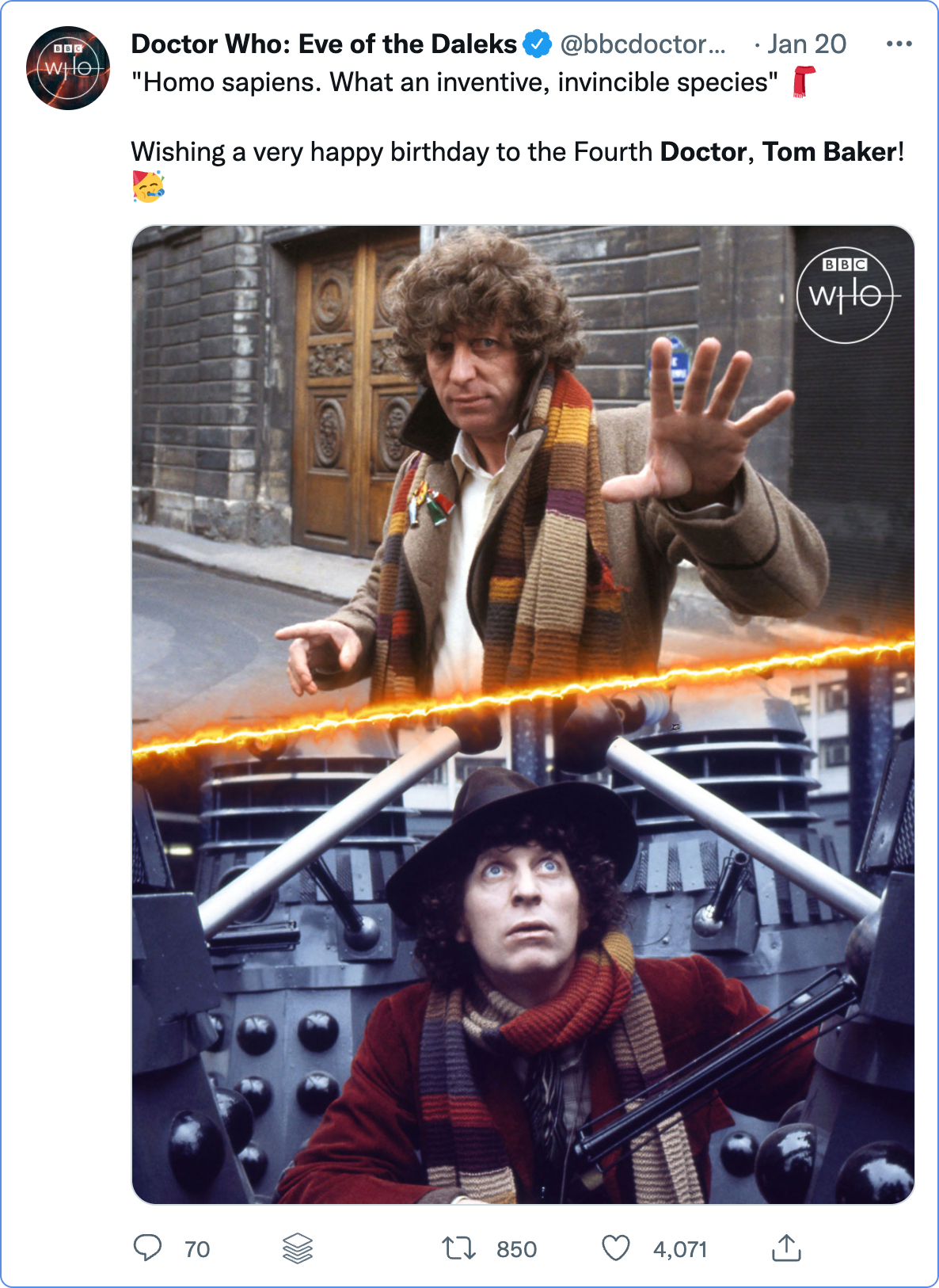
The Robots of Death shows the 4th Doctor at the height of his powers with Tom Baker encapsulating all the elements of the character that I love. In later seasons when there was more comedy injected, especially from Tom Baker himself it felt as if the series forgot some of its dramatic roots. “Robots” has a lovely mix of graveness from the 4th Doctor in this story whilst he still retains the ability to throw off other characters with an odd-ball comment such as when he offers Borg a jelly baby.
The Leela and 4th Doctor relationship in “Robots” feel a winning one with a really strong introduction in the story as the 4th Doctor is educating his new companion about how the dimensions of the Tardis work. It’s a new and interesting take to have the Doctor in the role of a teacher (The 4th Doctor does it again later with Adric ) educating in a Higgins/ Eliza Doolittle type relationship whilst travelling the universe.
I find the dynamic of Tom Baker and Louise Jameson really interesting as a pairing. Despite her costume created “for the dads” which could just make her a one-note character, Leela is more than just a savage. She wants to learn and understand those things outside of her experience without losing her primitive instincts. The writing from Chris Boucher uses Leela’s inherent senses to know when the sand miner is in trouble and also to be able to read people like Poul “He is a hunter” but still gives Leela a sense of wonder.
You try that again and I’ll cripple you
Leela to Uvanov
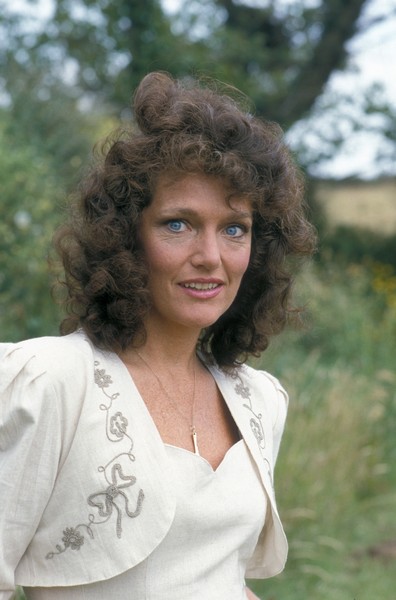
In Doctor Who – The Home Assistants of Death Louise Jameson comments with a broad smile “Yeah, still got it”. Personally, I’d say she’s never lost “it”. Maybe it’s her strong classical actor’s training but I think I am slightly in awe of Louise Jameson, to be honest. I met Louise Jameson in 2019 at the DWAS Capitol 4 convention, and the thing that struck me besides a pair of stunning clear blue eyes and timeless elegance is she is a hugely aware articulate actor. Louise celebrated in December last year 50 years since she was first on tv with her first appearance being on Cider with Rosie in 1971 ( see minutes 1852- 1922).
Given that Tom Baker didn’t at the time make her feel very welcome as he wanted to run solo as the Doctor some actors could have crumbled. It’s a real credit to Louise Jameson, that she gives Leela sympathy plus a ferocious intuitive wit throughout so many of her stories.
Chris Boucher has a lot of fun with the supporting cast who put in really good performances backing up the regulars. The murder mystery format does allow the actors to flesh out their characters and play more effectively any grudges as they blame each other when the murders stack up. I love that Chris Boucher takes time to build suspicion and makes the crew all quite different to each other. Chub, the cynic, raises the issue of faulty robot programming to Borg initially and then dies first. Borg, the strong man quick to temper and sees things in a very narrow way blaming the Doctor for the deaths when found in the hopper with Kerrils body.
The Doctor comments he was probably the strongest to put up resistance to the robot who kills him. Ivanov, the Commander, with a secret in his past, hated by Zilda but in turn suggesting he may have wanted more with her once the mission finished. Poul, is there to do a job that unravels understanding the truth. It’s a rich script centred around a simple premise of a murderer on board the sand miner. Everyone plays the script seriously and the story is all the better for it. Particular praise for me goes to Russell Hunter (Uvanov), Brain Croucher ( Borg), David Collings (Poul), and Gregory de Polnay (as D.84). Pamela Salem also puts in a sympathetic and measured performance as Toos. It’s great stuff.
If you haven’t seen The Robots of Death I would recommend it as an introduction to classic Who. The story came 11th in the Doctor Who Magazine’s first 50 years stories survey in 2014 and represents a fine example of one of the most popular and ironic incarnations of the Doctor there has ever been.
It’s an immersive story that makes you believe the society you are introduced to and the Doctor also finds a novel solution with helium to defeat the villain. Seven years in the role cemented Tom Baker in the role for a generation who even now can truly believe “The Doctor” is a tall chap, with “teeth and curls” in a fedora and a long, long scarf. Long may it remain so.


Comments
No one has left a comment yet.
Be the first and get the conversation going.