

Target Book Review – The Eaters of Light by Rona Munro

I was really glad when Rona Munro was given the opportunity to write for the revived era. Women writers in classic Doctor Who were scarce and only invited to write for the series in the 1980s. Rona Munro’s original series episode Survival in 1989 was conceptually out there, but as modern as the show needed to be and then gained the accolade as the final episode of the classic era. Seeing Rona Munro invited to return for modern Who felt progressive in terms of a series that has run almost 60 years but has had as many women writers as I could count on one hand.
It seemed like a symbolic bridging of the two iterations of the series but I did wonder whether Rona Munro would bring something as good as Survival in 1989. The Eaters of Light is a story that is based on a historical mystery of what happened to the ninth legion of the Roman army that disappeared in Britain around the second century AD also introduces the Picts, a group of ancient people who lived in Scotland and who fought against the Roman invasion.
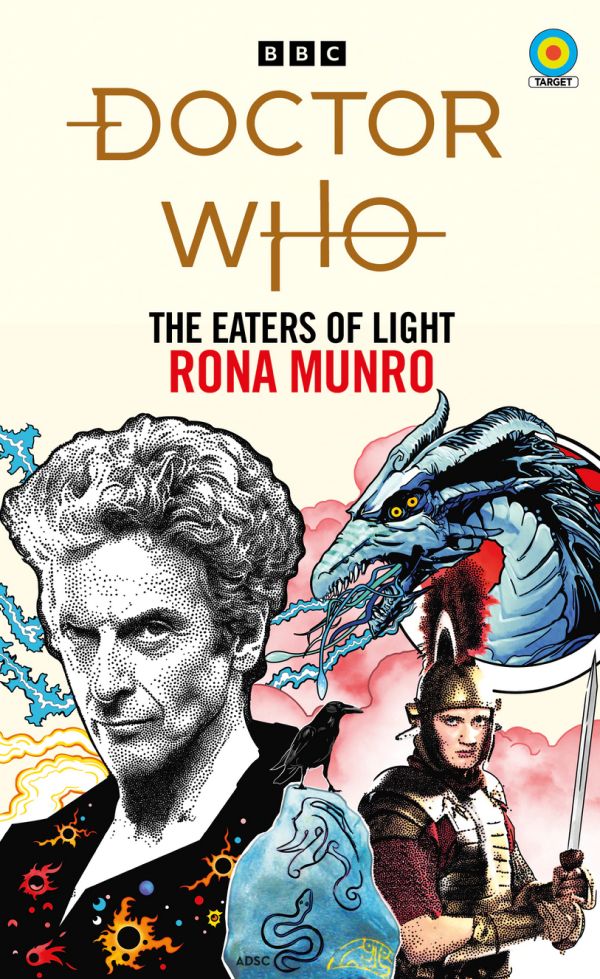
As it was I remember the transmission of The Eaters of Light in 2017 as feeling like solid Doctor Who but not extraordinary as television stories go. The Target book adaptation of The Eaters of Light has therefore sat on my shelf for a good few months but I felt quietly prodded by its presence. The book whispered hopefully quietly in my head let me show you that this story has far more depth than you expect. In all honesty, it’s all I’ve wanted for this story. I am a history buff and although I studied the Romans at school we were never told about the Picts or the missing ninth legion of the Roman army. I have welcomed the opportunity to learn about something new. Doctor Who educational remit ticked.
The historical elements of The Eaters of Light actually only take up around thirty-seven minutes with the rest of the time devoted to Missy’s story as she has taken up space in the Tardis at the Doctor’s behest (much to the disgust of Nardole) Those developments probably the decision of Steven Moffat does somewhat overshadow Rona Munro’s own script being as they are building up to the finale of World Enough and Time. The historical story itself therefore I feel on television got short thrift.
Rona Munro in the Target novel completely removes the Missy scenes and really invests in the main historical characters and creates a sense of a time and place by removing events or expanding others for the novel. One of my favourite scenes in the tv episode is when Bill first spots Kar who is honouring her parents in a forest clearing burning a rosary who sees Bill and then lets out a blood-curdling scream and chases Bill up the slope. Rather judgemental on Kar’s opinion, I think! Alternatively in the novel Bill is never in the clearing but ends up being chased by a bull from the family’s herd with Kar atop the bull. Kar then witnesses the creature attacking her bull who dies much to Kar’s sorrow.
“To protect a muddy little hillside, you doomed your whole world”
The Doctor
Munro splits the story into books. Book 1 covers the arrival of the Tardis crew in Scotland when they split and Bill meets the creature and is trapped with the Roman legionnaires and separately as the Doctor and Nardole are captured by the Picts. Book 2 concentrates on two young key characters Kar, the young woman, who through terrible circumstances has become the new gatekeeper to the dimensional gate and leader and Lucius, the eighteen-year-old Roman soldier who also leads what remains of the ninth legion.
The depiction of children and young people in episodic Doctor Who always feels a bit problematic as there is a tendency for some young actors to come across as inexperienced, annoying or quirky and there isn’t usually enough space in the episode to explore the anxieties of the characters It’s for me one of the most interesting parts of the book showing how they came to be who they are as it adds some context to the later conflict between the two young people. In the author’s notes, Munro describes a wonderful childhood roaming the fields and woods of north East Scotland with her dog and this emphasis on nature is reflected in the language of the novel.
There is an expansive section of book 2 where Munro’s language describes the symbiotic relationship between humans and creatures of the field. It is an innate knowledge that the tribe understand, appreciates and passes on through the generations. Life for a young Kar is spent exploring her local forests, a brimming paradise of life and feeling connected to the environment. Kar grows into a vibrant young woman, an “invincible sapling, brimming with green life”.
There is a sense of Kar losing her innocence as the battle with the Romans approaches and the tribe gathers its soldiers. Kar’s relationship with her brother Ban is explored in the context of a larger family including older siblings.
Using Munro’s love of myths and legends we are shown how Kar also listens and talks to the crows. They are shown as important allies, friends with Kar. I seem to remember at the time the tv story went out there was some online derision expressed at the idea that crows could talk. Unfortunately, with the time constraints the idea was mentioned but not expanded on although the book remedies this with gusto.
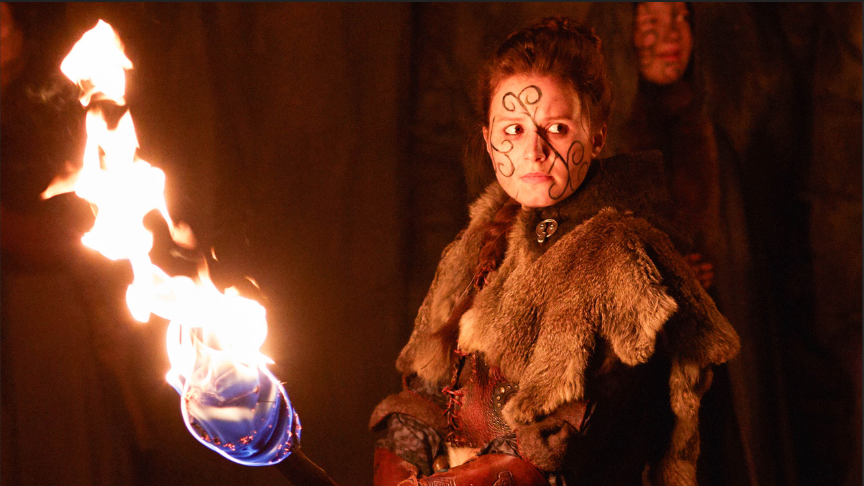
Lucius the young Roman soldier, who connects and forms a friendship with Bill is also prominent in Book 2. Exploring his young life supporting the gruelling family trade as a haulier and how he seeks escape by joining the Romans as a baggage boy. Munro uses the novel to explore the strength of a Roman legion that was 5, 500 strong. The sea trip of the legion to Britain and the capital Londinium, the heat of the Mediterranean cities really contrasts the cold march northward to Caledonia of the Roman legion. Having Lucius as a focus to show the deep bonds formed within a unit of men makes greater sense of the later sacrifice to guard the dimensional gate by the ninth legion.
He forms the closest relationship with an older fellow legionary Sextus which I don’t think we meet in the tv episode. This relationship replaces what I feel is a rather awkward and gratuitous conversation in the tv episode where Bill explains that she’s only attracted to women, and he discloses he and his fellow Romans are mostly bisexual. The conversation between Lucius and Bill in the tv episode bonds them but in the novel isn’t there as much as there is a greater emphasis on Lucius and Sextus and how the relationship is a pivotal but very important aspect of his young existence.
The antagonism between Kar and Lucius is given more emphasis in the novel but then also is the understanding of each other through their overwhelming sorrow and grief. that Lucius and Kar have both suffered losses and have had to take on a mantle of responsibility. As the “tribes” come together to stop the creature from devouring the sun it feels ultimately more moving.
Rona Munro in the novel creates a far more hideous depiction of the creature than could be seen on television as it wreaks havoc on human and animal life. The prologue sets the scene where the lizard-like creature has defeated the Pict warrior guarding the dimensional gate who is described as a “shrivelled, blackened husk of a man” clawing his way out of the darkness. Kar is shown as ashamed having let the creature escape the cairn to attack the legion but she felt raging anger when most of her family died and wanted revenge. Following the eventual battle between the Picts and Romans the creature attacks the ninth legion on the brink of victory against the Picts.
There is a description of writhing tentacles which attack indiscriminately to squeeze the life essence out of any soldier who tries to attack the creature Both Kar and Lucius are witnesses to the slaughter although we only see a very brief section of the massacre of the legion on television. Described from Lucius’s viewpoint within the battle the images haunt his grief when he loses the love of his life.
Book 3 brings the Tardis crew back and the Picts and the remains of the Roman Legion together. Bill has always been a bit opinionated and I do like how she at once wants to hug the Doctor when reunited but also challenges his need to be a hero guarding the gate better than the humans which comes across far more forcefully in the novel than in the tv episode. Matt Lucas did such a good job with Nardole in series 10 and Munro easily translates him into the book. I love some of his humour as he tries to fit in with the tribe but is always able to chide the Doctor which adds an element of much-needed balance with some lightness to the proceedings.
The 12th Doctor can be quite an angry character and one of the positive aspects of the novel is whilst the 12th Doctor doesn’t lose his natural sarcasm some of the more childish cutting retorts in the tv episode to the young Picts are played down. His thought processes are expanded upon when explaining how the creature will be contained and trapped and it’s good to see a knowing gentle tone with Kar at times understanding her grief.
Overall, this Target novel delivers what’s expected with a traditional monster story. The monster isn’t the important bit though it’s the humans. Rona Munro succeeds within the novel because she doesn’t only recreate what was in the tv episode. She reimagines The Eaters of Light to explore the human perspective of loss and what the ultimate sacrifice entails. Using influences from a happy childhood Rona Munro weaves a story that ultimately satisfies in a much richer way than the television episode had time to do.


Comments
No one has left a comment yet.
Be the first and get the conversation going.