

The Great Virgin New Adventures Review: Set Piece & Infinite Requiem

As we continue looking back over the Virgin New Adventures books from the 1990s, we’ve reached another milestone, Set Piece sees Ace finally bowing out of the series, but how does it compare to her other departures in the range? And is this a Kate Orman book that I actually enjoyed?! And Infinite Requiem sees the Doctor trying to get over Ace’s departure, while Bernice is trying to remind him that she’s still there!
Set Piece
Written By: Kate Orman
Ace’s departure had been building up for a little while in the range before Set Piece came along, with the Doctor noting that it wouldn’t be long back in St. Anthony’s Fire and Ace even ponders on her departure in the previous two outings, Parasite and Warlock. Set Piece seems to make them separate permanently almost from the very beginning, with Ace finding herself stranded for a long period of time in Ancient Egypt, while the Doctor is elsewhere.
It seems clear too that Ace’s departure was on Orman’s pitch, as she makes no will-she-or-won’t-see looks at Ace’s passages in the book, with the Doctor appearing to be dead at the beginning and the companions split up, I really enjoyed Orman’s treatment of Ace, with her almost expecting the Doctor to turn up when she needs him the most and he isn’t there. Sentences like “And then the Doctor…didn’t appear,” really did feel like a gut punch that you could feel as Ace gradually comes to the realisation that her friend isn’t going to be coming for her. If the Doctor not being there wasn’t bad enough, Orman doesn’t shy away from Ace finding out what life for a woman in Ancient Egypt was really like. While she does become the very best palace guard, she struggles to find any other work when she leaves and very quickly realises how miserable her life is going to become.
When the Doctor, Ace and Bernice finally meet back up, the Doctor knows that it won’t be long now before she leaves, but Orman treats it like part of a process, with Ace wanting to belong somewhere but knowing she can’t change history. And leaving the Doctor behind in Napoleonic France and not changing anything would be very hard. But in a timey-whimey twist towards the end that predates River Song by many years, Orman leaves the pair with a way of meeting up whenever they want. I wasn’t a huge fan of Orman’s other entry into the range, The Left Handed Hummingbird as it was one of the darkest books from the series that I’d read, so it was nice that Ace’s departure wasn’t some big and dark thing. Instead, it felt, as the whole book did, like a celebration of the Doctor and Ace’s time together.
There are many nods and references to past adventures both from the books and the television series, with characters unintentionally repeating famous lines from the series and Ace doing things like comparing Ancient Egypt to Ancient Mesopotamia.
And while Ace leaving forms a large part of the book, what about the main plot? Well, that concerns a large time-ship that has gone mad and made creatures called Ants, made up of metal and organic bits, in a weird cross between creatures like the Cybermen or the Borg. But I wasn’t too sure what to make of the book’s main plot, mainly because it wasn’t really there for most of it, in fact, the ship’s defeat felt quite rushed at the end of the book, with only a few pages left. I can’t help but wonder if some of the padding in the middle could have been chopped out and the Doctor downloading a virus into the computer feels like quite a ‘can’t be bothered’ ending.
But then the book isn’t one of the longest in the range so I do have to wrap up pretty quickly. And I also noticed that there were a number of proofreading issues, with speech marks missing, paragraphs starting where they shouldn’t, words being misspelt. I wonder if this book hadn’t been sent to be proofread and was just hurried to the printers instead? While it doesn’t stop the enjoyment of the book, most of the mistakes are very noticeable.
Orman also has a great handle on Bernice Summerfield, even if she doesn’t feature too much. Still, it’s good to note that she and Ace finally like each other by this point so when she says goodbye to Ace, it does feel earned, like these characters have gone through some things and gradually come to like and respect one another. She rightly seems shocked that the Doctor would leave Ace behind in this period of history.
But the Doctor makes it clear that it’s Ace’s choice. But I can’t help but feel sorry for Bernice at this point, she’s been in the range for a while but never really featured by herself in a great book yet. From Infinite Requiem, we’ll be treated to a few solo outings for Bernice so hopefully, she gets that one great-companion story that she deserves as I much prefer her to Ace in these novels.
Set Piece sets out to be Ace’s final adventure and on that front, it succeeds, it’s light and nowhere near as dark as some of the other books which I really enjoyed. Ace is served brilliantly and it celebrates her time and character through television and novels brilliantly. But I’m not sure that the main plot comes across as well, feeling secondary to everything else that’s going on, so much so that the true baddie doesn’t feel like a threat at all and is more of an afterthought. As a companion departure, it works well enough but as a Doctor Who story I think it needed one more final draft to really get it amongst the greats.
Infinite Requiem
Written by: Daniel Blythe
Perhaps for the first time since this series of novels started, we’ve finally gotten something completely new! Set Piece saw the departure of Ace, and although I know there are a few cameos to come from her, Infinite Requiem finally sees the new adventures of The Seventh Doctor and Bernice Summerfield kicking off.
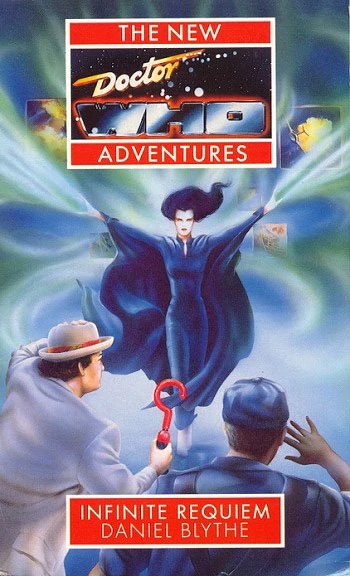
Blythe’s previous outing in the range, The Dimension Riders was a good enough read, but not one that I’d think this author would be back for another round. And while he handled the main characters, Bernice in particular, really well in that previous book, but that’s not so apparent here, with the Doctor and Bernice being in Infinite Requiem but that’s about it. Instead of giving the two regular characters some great moments of their own, he decides to focus on his other characters, making who should be the main characters feel secondary. What also doesn’t help is that the prose jumps about from location to location with such speed that there isn’t any time to really enjoy any of the characters on offer here.
The book launches into a battle on the planet Gadrell Major, which only begins to highlight some of the pacing problems with the book. There are too many characters introduced in too short a space of time, and characters being described indulging in flashbacks don’t help with the pacing issues either. The fun of reading about a battle is lost when all the characters wished they were somewhere else.
Ok, I should imagine that if you were in a war, you’d wish you were somewhere else, but come on, how are we supposed to care about any of these secondary characters if they don’t actually get any character. It’s not as if these novels haven’t handled similar topics before and done them better. There is a sense of patience and respect that are missing from these characters, something that stays with them throughout the book’s runtime.
Blythe also brings back a character from his previous book, Darius Cheynor, and it felt like it should have been a big reunion when he teams up with Bernice for most of the book. Unfortunately, I had no recollection of him at all, so his return was lost on me. Not that he gets much to do either, just trying to find a way of ending the battle with the mysterious Phractons, with peace. But that is handled so boringly that any excitement I was supposed to feel about his return was completely lost on me.
Where the story does pick up is in the modern-day passages, or the 1997 setting. There we meet a woman who is pregnant with a psychic foetus, yes really, an abusive lover and a family that has turned their back on her. It’s handled well and with some care and pathos, there’s even a rather exciting bit when an ambulance carrying her in labour crashes and nearly kills the Doctor. It’s a shame that the 1997 strand of the story doesn’t last too long but the Doctor takes the baby which grows up very quickly and is used as a host by a creature called a Sensopath but is then bundled into the zero room for most of the book, occasionally the character telepathically communicates with the Doctor, but I’m still unclear on how they helped defeat Shanstra, the big bad, towards the end.
I’ll give Blythe his due, he does try to deal with the idea of psychics and gives us a few different versions throughout the book. You’ve got the Sensopaths, the Phractons, psychic blobs in glass jars, the Pridka, who run a dream centre and some telepathic humans. But somehow he still manages to make them all completely uninteresting with the Sensopaths in particular just being the generic baddies. It’s a wonder why the book makes such a fuss about all this telepathic stuff if it doesn’t come across as particularly bothered by it.
The thinness of the plot doesn’t really make there too much else to talk about. It doesn’t seem to have the guts to be a completely terrible book nor does it have any to be one of the best reads from the series. Instead it just kind of languishes in an in-between. There are ideas that some readers will enjoy but for the most part, nothing really comes to anything. Things aren’t really wrapped up and I’m still not sure exactly how the Doctor defeated the big baddie.
The first proper outing for the Seventh Doctor and Bernice leaves a lot to be desired, especially for a pair who deserved so much more.



Comments
No one has left a comment yet.
Be the first and get the conversation going.