

A Tribute to Verity Lambert: Riverside Studios Shoulder to Shoulder Screening & Panel
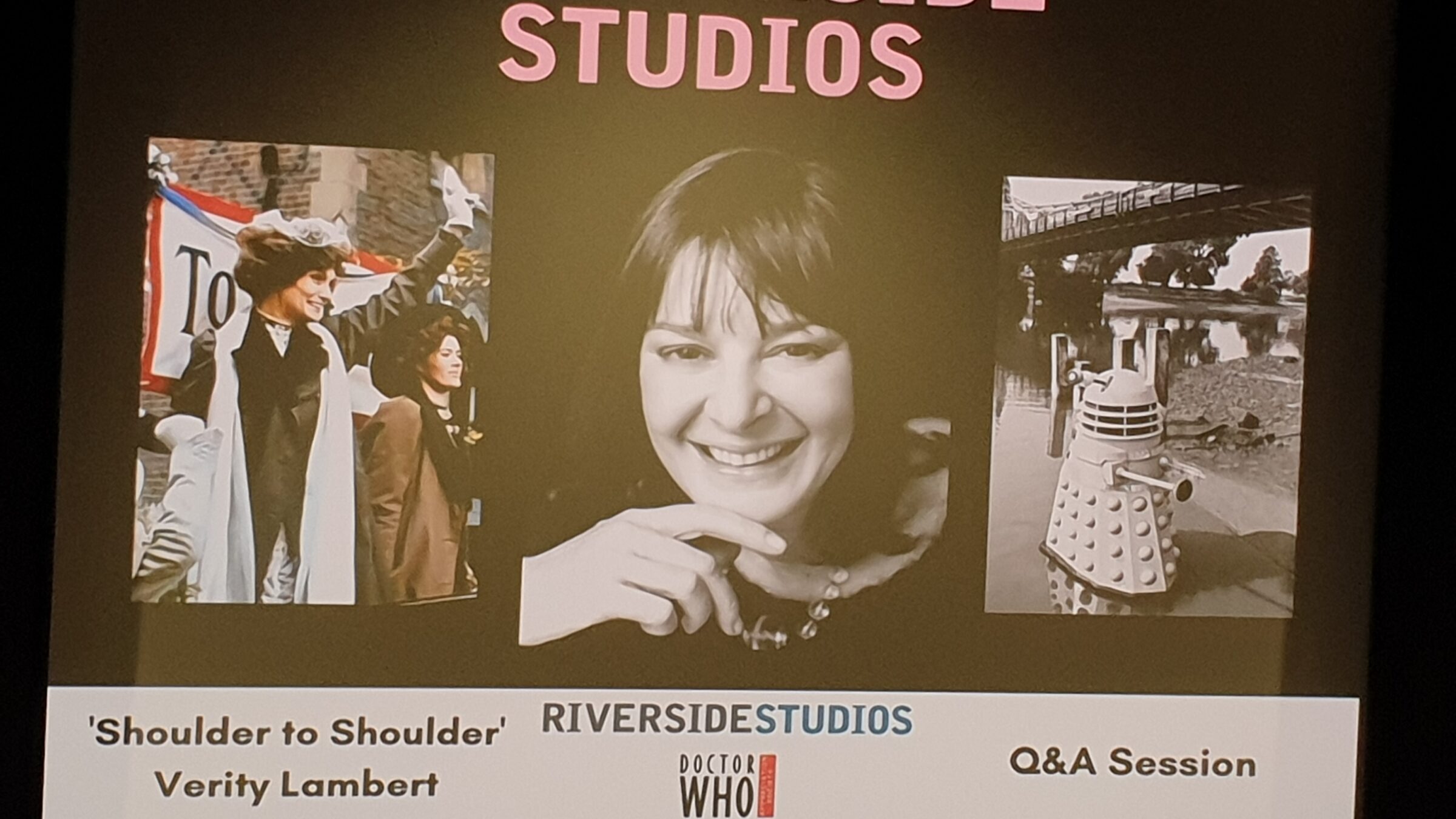
On Sunday 29th May, Riverside Studios, in association with the Doctor Who Appreciation Society, held a screening of the first episode of a BBC television serial called Shoulder to Shoulder. Produced in 1974 by Verity Lambert and directed by Waris Hussein. It relates to the history of the women’s suffrage movement.
The screening was an opportunity to pay tribute to Verity Lambert, Doctor Who’s first, but also the youngest female producer. The website of the Museum of Broadcast Communications described Verity as “not only one of Britain’s leading businesswomen but possibly the most powerful member of the nation’s entertainment industry. Lambert has served as a symbol of the advances won by women in the media”
Verity Lambert produced a huge amount of work over her career spanning five decades. Some of the more familiar or notable dramas include Adam Adamant Lives! (1966–1967), Shoulder to Shoulder (1974), The Naked Civil Servant (1975), Rock Follies (1976), Quatermass (1979), The Flame Trees of Thika (1981), Widows (1983), Minder (1979–1984), G.B.H. (1991), Class Act (1994), Jonathan Creek (1998–2004), Love Soup (2005–2007), as well as Doctor Who: A Happy Ending (2006).
The re-unveiling of the Verity Lambert Plaque
Before the screening, there was a re-unveiling of the Verity Lambert plaque by director Waris Hussein and former showrunner Steven Moffat amongst a crowd of Verity’s friends and colleagues. Originally dedicated in 2014 by Waris Hussein at the entrance to the restaurant inside the theatre the blue heritage plaque was placed in storage when the studio complex was being redeveloped. It now has a permanent new location at the studios.

Time Lords to Top of the Pops
Running at Riverside Studios there is also a free stunning collection of photographs taken behind-the-scenes of the most iconic BBC programmes made in the original building, from Doctor Who and Hancock’s Half Hour to Blue Peter and Top of the Pops. This is part of the BBC Centenary to celebrate the programmes made at the studios. Complementing the free photography exhibition are screenings of classic programmes from the BBC archive. Events run from Thursday 21st April through to Sunday 24th July 2022.

Screening of Shoulder to Shoulder
It’s such an interesting choice to pick Shoulder to Shoulder as a tribute to Verity Lambert. The 6-episode series covered the period from 1895 to 1919, opening with progressive Labour candidate Richard Pankhurst, potential MP for Gorton in Manchester, campaigning amongst poor working-class folk believing that socialism would triumph. He is unsuccessful but when he dies three years later due to stomach ulcers his wife Emmeline and elder daughters Christabel and Sylvia became influencers and activists for women’s rights. The struggle of early 20th century women to be given the vote does resonate some fifty years later with the sexist attitudes from some of the BBC establishment towards Verity as a producer.
Unfortunately, the issue of gender equality is not newly debated between men and women. In ancient Greece women, slaves and foreigners were excluded from the political process. Greek philosopher and polymath Aristotle emphasised in his writings how only men possessed speech and reason which thus made them political beings. The common perception of women up until they gained the right to vote in 1928 was as ‘natural’ creatures. The idea of nature is something that is seen outside of the political arena and women historically were focused primarily on the domestic and were often in menial roles doing repetitive tasks.
Described as a passion project for Verity Lambert what is refreshing about Shoulder to Shoulder is how the series didn’t shy away from showing women, oblivious of their position in society, discussing political ideas and becoming increasingly militant for the vote and the reality of the consequences inflicted upon them including imprisonment and force-feeding.
A Powerful Woman
Two of the stars of Shoulder to Shoulder were Dame Siân Phillips, who played Emmeline Pankhurst and Patricia Quinn (Lady Stephens) who played Christabel Pankhurst and they discussed their first meetings with Verity. They were part of a panel with Shoulder to Shoulder director Waris Hussein and Doctor Who original Carole Ann Ford who played the Doctor’s granddaughter Susan.
What emerged was a picture at that time of a formidable woman, powerful but at the same time ordinary and admirable. Siân Phillips described feeling intimidated initially by Verity but not knowing what a formative experience in her career meeting Verity would be. Patricia Quinn gave a hilarious anecdote of turning up to the audition in dungarees and glitter as she was in “the Rocky Horror Picture Show” playing at cinemas at the time and the nice surprise of the audition panel for Shoulder to Shoulder turning up at the cinema to deliver her script to say she had the part of Christabel.
Patricia Quinn described herself as a particularly fussy actress when younger who was unsure initially about the part but on reflection saw the series had brilliant writing and was prestigious enough to be given a Radio Times cover. Unfortunately, Shoulder to Shoulder hasn’t been reshown on BBC television since 2008 and is unavailable to buy but copies are held at the BFI (British Film Institute)

Patricia Quinn was also thrilled to mark off her bucket list later working on Doctor Who in the 7th Doctor story Dragonfire as Belazs. Patricia lamented the lack of glamour however in being asked to wear a uniform and hide her redhead under a helmet or have her hair up. With her dry sense of humour, she commented this was apparently all due to Bonnie Langford having her long red hair down and she wasn’t allowed to do the same as a guest.
She certainly didn’t walk into it!
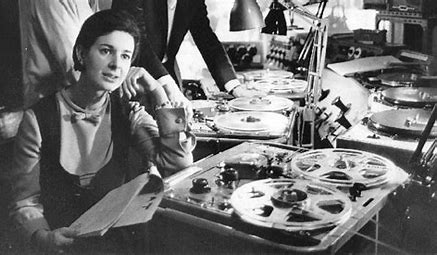
Waris Hussein also recalled his friendship with Verity Lambert beginning with Doctor Who. He remembered as a young director he was very keen to prove himself as another director had walked out on the BBC production The first time he met Verity he walked into an office and saw “a very elegant woman with Vidal Sassoon hair which she always wore very well” He felt Verity trusted him although his initial thoughts after reading the first four episodes were, as an Indian born Brit with an accent educated at Cambridge, “How do I direct this script?” of cavemen and cavewomen.
Waris revealed he and Verity developed an incredibly close friendship as fresh young outsiders within the staid establishment of the BBC. He described how Verity, being very attractive, when she walked down the corridor people would look and speculate how she became a producer. Waris in a heartfelt moment revealed how he missed his friend and had huge respect for her. Verity never dominated a scene he said but advised and he considered Verity saved him with her support on Doctor Who.
One story Waris told was of the only time they fell out which was over a sound effect. There is a scene in An Unearthly Child where one caveman attacks another with a rock. Waris had arranged in the studio to use a melon and create a squidgy sound as the rock fell on the caveman’s head. Verity objected on the grounds Doctor Who was a children’s show that sound couldn’t be used.
Waris in the control room declared he was the director and threatened to leave but Verity eclipsed him as the producer and got the final say that the effect was left out. In the story Marco Polo Verity however allowed Waris to have his request of a spider monkey which then escaped into the production gallery and did what a frightened animal would normally do a make a mess… he commented she later told him she knew it would happen!
Waris Hussein also discussed some of the challenges of working on Doctor Who, the process of directing and how preparation was key with four large cameras and cables everywhere. The interviewer described his work as progressive with the use of a single camera and location work. Waris acknowledged it was a strategy based on when he met the American film director and producer George Cukor who gave him the advice which he used to “never let people get bored “
Mysterious Girl, Unearthly Child
Carole Ann Ford was asked about meeting Verity and described how she played the Doctor’s granddaughter Susan as quite mysterious for her audition. This was based on how the character had been described to her as a telepathic alien. Since leaving the show Carole Ann, in interviews, has talked about her dissatisfaction with how Susan was changed to be written as an ordinary teenager.
Waris Hussein took an opportunity at this panel to explain how Susan had to become more “girl next door” for the tv audience on the instructions of Head of Drama Sidney Newman. Even though the pilot for Doctor Who was initially seen as unsuccessful which led to a very difficult conversation in a Chinese restaurant with Sidney, he still considered Sidney had a very good instinct about what would appeal to an audience and should be acknowledged more in the success of Doctor Who.
Was Verity surprised at the longevity of Doctor Who?
A question came from the audience and whilst Waris Hussein admitted he never asked Verity both he and Patricia were surprised at how Doctor Who has lasted. Carole Ann Ford regretted that William Hartnell wasn’t alive to ask as she said he wouldn’t have been surprised. Bill Hartnell, she stated believed it would last forever. The option of regeneration opens up so many possibilities Carole Ann Ford explained and “Bill would have loved it “and also the fact that so many people love the programme.

The Last Word
The final contribution came from Anna Callaghan, personal assistant to Verity Lambert who was in the audience. Anna knew Verity from 1997 and she said Verity wouldn’t have been surprised at all at the shows continuing success and would have been delighted. Anna revealed that when the series was mooted to be reborn, Verity was the first person to be approached and she very politely declined to say it was wonderful to have done it but it was time for somebody new to do it.
Anna revealed she knew how hard Verity had fought for William Hartnell to be the Doctor and also much later she later fought for actor George Cole to play Arthur Daley in Minder. Both actors went on to create iconic well-loved characters in popular culture.
As with an earlier comment, from an assistant floor manager called Rosemary who had worked with Verity, Anna confirmed Verity was extraordinary loyal and was hands-on pitching in carrying camera equipment to support the cast. Verity wasn’t however a person to hover over a director’s shoulder. Anna recalled her strength in scripting editing and attention to the written word for a series called GBH was written by Alan Bleasdale.
Bleasdale was a prolific writer and his scripts were very heavy. Verity would use a blue pen to cut forty pages of script much to his chagrin. Alan Bleasdale had cursed her at the time profusely but had to acknowledge upon seeing the finished product which won two Baftas in 1992 that she was inevitably right.


Comments
No one has left a comment yet.
Be the first and get the conversation going.