

Harry’s Who Marathon: Season Three

Welcome back dear reader to the written account of my epic Doctor Who marathon! We have so much to explore in the jam-packed Season Three. First off, the elephant in the room. Yeah… it’s been a while. A year? Funnily enough, it isn’t just life stuff that grabbed my attention away from 1960s Doctor Who; the reasons for my absence are intrinsically linked to what I thought of these seasons. Let me explain…
So for anyone who doesn’t know, in November 2022 I started a marathon of all of Doctor Who from the very first episode in 1963 up to whatever the current episode is by the time I finish. And I reckoned every two months or so I could present you with an article that would update you guys on my progress. It lasted for two seasons – you can read my thoughts on Seasons 1 and 2 now!
Funnily enough, I have made it into Season 5 now – I just finished The Enemy of the World yesterday. I neglected to write about it all because I was mainly focused on… well, just getting through it.
GASP! Did I find it boring? Terrible? Am I just totally wasting my time watching a TV show I don’t like?
Well, no. It’s complicated.
When I fell in love with Doctor Who in 2005, it was a very particular brand of the show. It had modern ideals, acting, and production values – and all these things continue to be more modern still (we’ve just had our first major trans character!). This love is so strong that I have never stopped obsessing over it, and any foray into the show’s classic years would be taken with more, shall we say, care than any other show.
Generally speaking, maybe as an autistic man who likes bright colours or as a Gen-Zer who constantly needs to be stimulated, I wouldn’t go out of my way to watch black-and-white television. I do find It’s A Wonderful Life to be gut-wrenching and I find Laurel and Hardy blooming hilarious. But with regards to most black-and-white media, I am perhaps more inclined towards finding it shlocky or of a less exciting pace to the TV that I am more used to watching.
And let’s face it… 60s Doctor Who, as much as it is funny, adventurous, creative, weird, intelligent… it is also dumb, dull, badly acted, and amateurish. This is very obvious in a season like this one, which we will discover is a mixed bag. It was made at a different time when TV was simply broadcast and barely preserved; it was more disposable. It had different standards to reach, and to highlight that my intention isn’t to sound snobbish with these opinions, I want to point out that I am fully aware of these different standards. As I was having to remember this context while I was watching the William Hartnell era, I struggled to continue watching an episode every day like I had initially set out to do.
What didn’t help my struggle for consistent engagement was the fact that there were so many missing episodes! It became tough to watch what was essentially another slideshow of a missing story, which can never really capture any magic in the original episodes. But thankfully, we are lucky to have gorgeous, full-colour animations of certain episodes which have vastly increased the watchability for me as we continue the marathon.
Of course, epic quests such as this have peaks and troughs, and though I have been a bit bored at times, it has all been part of an overall fascinating process of seeing how the show developed in its early days and throughout chronological episodes. So, let’s dive into it. This time, rather than covering every individual episode, we are going to talk about whole serials.
See you later Vicki!
We begin with Galaxy 4, where the Doctor, Stephen and Vicki are on their next adventure on a planet where two races – the Drahvins and the Chumblies – are falling out with one another. The Chumblies were as cute as they were freakish, to begin with; I felt that the Daleks had competition.

But slowly we realise that the Chumblies/Rills/cute robots aren’t the baddies, but it is the Drahvins controlled by their maniacal leader Maaga who want to infiltrate their ship.
The story runs out of steam by the end; the Rills were so helpful to the Doctor and Co that I didn’t worry particularly about the once acute threat of the planet exploding before they could leave. But I enjoyed how this story misdirected me.
It is a shame that only episode three survived, but we are lucky to be able to see the incredible performance of Stephanie Bidmead as Maaga in her terrifying monologue straight to the camera where she fantasizes about everyone left on the planet dying once the Drahvins leave. Awesome stuff.
We get an unusual addition to the show in the single-part story Mission to the Unknown, made more unusual by the absence of any of our main cast. The episode follows UN Deep Space Force members Marc Cory and Gordon Lowery investigating a possible Dalek base. Dun dun dun!
As interesting as it was to have an episode that goes against the status quo in this way, there simply isn’t enough time to get to know and like these characters enough and make their demises more impactful. What is tantalising, however, is the Daleks launching their grand plan to take over the solar system, starting with Earth. The Doctor and co have got a big battle on the horizon… how exciting!
Except… the next episode is all about the Trojan Horse. A little random, but whatever, we roll with it.
I started off enjoying The Myth Makers. An opening sword fight scene, pompous acting, and the Doctor being mistaken for Zeus. Stephen disguises himself as a Greek soldier – brilliant! I also appreciated that just like The Time Meddler last season, science fiction is also an integral element of the story, with our heroes outright disclosing that they are from the future and have value to those who wish to kill them.
Sadly, I started to get a bit confused as the story went on, once again feeling that I was not familiar enough with the historical context to get certain plot specifics. And then I got even more confused when I unexpectedly heard the Doctor say something about an orgy!
The story culminates in a rushed conclusion, and I am left feeling not a great deal for any of it. Vicki leaves rather abruptly to pursue an interest with Troilus, whom she has just met. And it is a shame that we didn’t have more time with her, Steven, and the Doctor together, as they were shaping up to be a promising TARDIS team.
On the bright side, we meet a new companion in Katarina, a Trojan servant who finds herself on the TARDIS. Fetched right out of history, I wonder how far her adventures in time and space will go!
So, Katarina just dies…
The goliath that is The Daleks Masterplan goes on for way too long. But surprisingly, for twelve episodes, it manages to just about sustain a good quality throughout.
We start on the Jungle Planet with the Dalek base. The Daleks’ titular plan to conquer the ENTIRE SOLAR SYSTEM is terrifying and insane If things weren’t dire enough, the Guardian of the Solar System (Mavec Chen, unfortunately yet another Asian character played by an English actor) is on their side.
The Doctor is trying to spy on his old foes, to begin with, along with Katarina, a dodgy Space Agent Bret (played by the legendary Nicholas Courtney), and Stephen, who is stupidly ill. Things couldn’t get more chaotic! It is unclear what Chen’s motivation is to begin with, which is very intriguing. And of course, the Daleks are so Nazi-esque, they plan on exterminating Chen as soon as he is no longer useful. Already the Daleks bring their familiarly terrifying tropes.
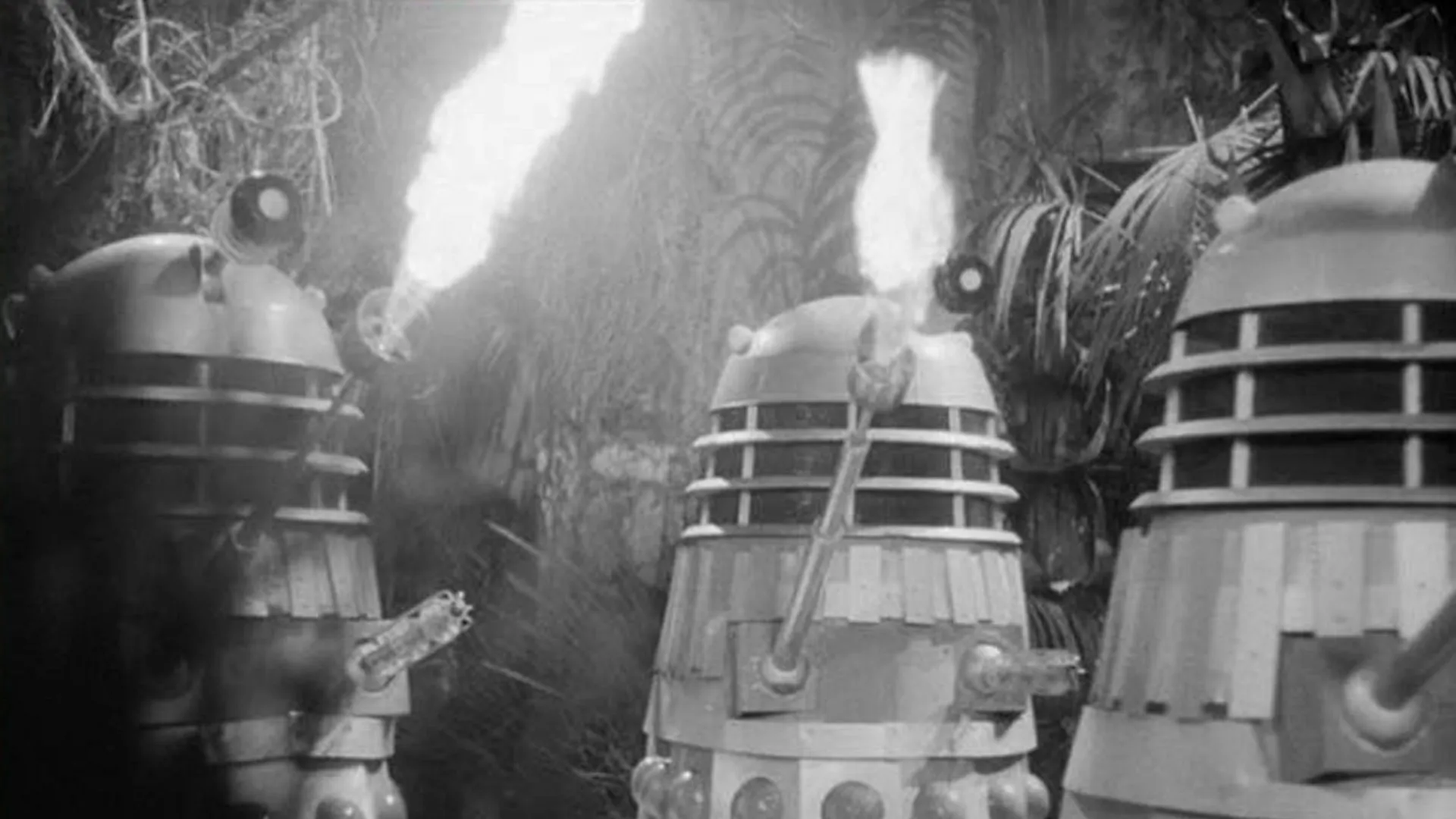
Our heroes Chen’s ship ends up on a prison planet that has no guards or supervision – just prisoners milling around. A great little concept thrown in by Terry Nation (he sure loves them). And then we get to see the Doctor develop a relationship with Katarina, treating her like another surrogate grandchild. Could it be that she sticks around and can fill the Susan-shaped hole in the TARDIS?
Nah, Katarina gets killed off by episode 4.
Abrupt, yes. While the first five minutes of her last episode were incredibly gripping and well performed by the actors, resulting in an eerily sad demise, I question the intention to put it at the start of the episode and never mention it again.
I also feel that it would have been more impactful if Vicki had stayed a few extra episodes and she was the one in Katarina’s shoes. It would have torn me apart, and I’d have applauded the show even more. Speaking of death, Bret’s sacrifice to save the Doctor and Steven from the ruthless Sara Kingdom was a nice end to his slightly douchey character. And we got a little more insight into Chen’s motivation; he seems hungry for power in a similar way to the Daleks. He also thinks that he is more powerful than the entire Dalek race, showing absolute corruption of power. I wonder if he is an allegory for corrupted political leaders. Oh, who am I kidding…
As the serial went on and on a little bit, I came to realise that Sara Kingdom, the sort of companion who turns up to fill Katarina’s spot, is only there to fill the spot. She reveals Bret is her brother and that is never mentioned again; no character arc.
And then the plot just stops for an episode to celebrate Christmas. Our heroes are in a police station, and then a film set, and then the Doctor is racist towards Arabs and wishes the viewers at home a Merry Christmas. I mean, some of it is charming, but it is ultimately tacky and pointless filler.
Oh, but the Meddling Monk returns! That’s fun. And the Daleks continue working on their time machine that they will use to dominate the universe. Some fun things to witness, but it is still going on and on…
Then you realise the Monk is kind of just in the story for no reason at all. And we are getting nothing about Chen’s backstory. Terry Nation isn’t even writing all the episodes at this point. Did I mention it’s still going on?
Luckily the tension ramps up some more towards the end. Chen reaches the height of his madness which ultimately results in his death from the Daleks (shocker), who are more vindictive and spitefully evil than ever. The Doctor manages to heroically destroy the evil time machine – the ‘time destructor’ – and Sara sacrifices herself to help.
Though Sara has overall been a boring addition to this serial, her death was particularly horrendous and effective, and the serial ends with the Doctor and Steven solemn and miserable at the losses they have suffered, even though this really should be a happy ending. With the amount of bloodshed, all so needless and maniacal, it makes perfect sense for this 12-parter to end this way. A very brave move indeed.
OK, that is the end of that. While the serial does suffer from its length, it has so many interesting quirks and strong elements to it. The longest Doctor Who story to date, for these reasons, is pretty good, when it could have easily been pretty average.
Steven rants unhappily, and Dodo arrives snappily
Maintaining a downbeat tone, we enter The Massacre, which focuses on a violent conflict between Catholics and Protestants in 17th-century France. It would be lovely to have a cheery France-set story, but I think I will have to wait another 14 seasons for that one.
And it starts off being boring as hell! At times I forget I am watching Doctor Who, and I have instead stumbled on a slow-paced historical drama from the 60s that I wouldn’t ordinarily watch. Not to mention, little is done with the opportunity for Hartnell to portray another character in the Abbot. But there is merit to be found. Steven becomes a more likable character, having to navigate a tumultuous period all by himself while the Doctor goes to see a famous scientist he admires (the selfish pillock!).
And the final episode certainly steps up a gear. The massacre itself is depressing and brutal, providing a disturbing window into the real historical event. Anne Chaplet, who we have grown to find endearing with her interactions with Steven, was left very likely to her death by the Doctor, who chose not to save her. And my brain is left teased, thinking who makes more sense here? The Doctor, who understandably doesn’t want to rewrite a line of history with potentially catastrophic consequences? Or Steven, who struggles to get past the innocent life lost and understandably leaves the TARDIS in disgust with the Doctor? Culminating in a lament by the Doctor, where he shows a depth of emotion we don’t usually see as he name-checks all the companions he misses and briefly considers returning to his home planet, this has to be the most compelling episode this season.
BUT NEVER MIND ALL THAT. Steven decides to come back, Anne’s descendant Dodo Chaplet randomly stumbles into the TARDIS and quickly becomes another part of the crew, the Doctor is laughing and smiley again, and then it’s time for more shenanigans! This show is an effing rollercoaster.

And then we have The Ark, which is brilliant! What a stupid yet brilliant idea to have a colony of humans on a planet with a jungle and a city, and the planet is actually on a SPACESHIP with aliens that have eyes in their mouths and the biggest threat to mankind is… the common cold. How can you not love that?! Furthermore, we are treated to silly costumes, impressively wide camera shots of the terrific sets, and an elephant – an actual elephant! All in all, it is a highly entertaining story that is superbly realised for the budget and resources they had at the time.
‘Well, that’s alright then!’
We have the origins of the Toymaker, the Doctor’s most powerful enemy yet before he shows up decades later in The Giggle to fight the Doctor once more. Certainly, The Celestial Toymaker offers interesting set pieces (which are painfully underrepresented in telesnap reconstructions; maybe the new animation fixes this?), and promises a bizarrely fun story.
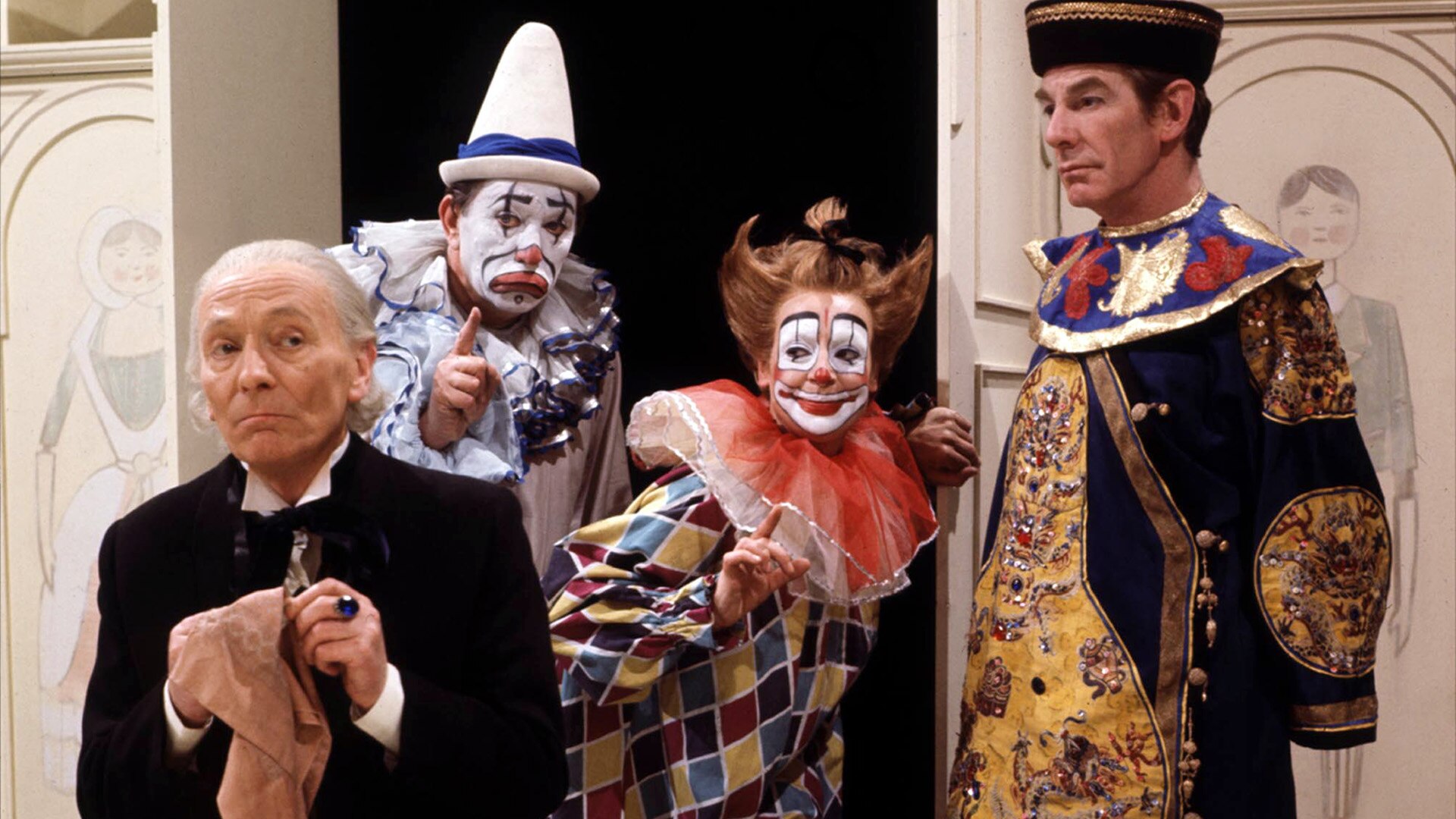
What we get instead is a badly formulaic and outdated story which honestly prevents me from liking it all that much. The Doctor is frustratingly absent for much of the proceedings once again, and the power with which the Toymaker is set up is diminished by the rather easy resolution in the closing moments.
The Gunfighters begins with the Doctor needing an emergency dentist appointment (hard to believe we were fighting Daleks a few weeks ago). The Wild West is an entertaining setting to explore, with Steven and Dodo loving it, the Doctor being somewhat more begrudging, and a case of mistaken identity resulting in the Doctor’s life being in danger – some cowboys have the wrong Doctor! With the weirdness and darkness of previous episodes this season, this lightheartedness is a required gear change. This serial is very funny.
For every time I hear Steven’s cringe American accent, I smile when I hear a different variation of the ‘Last Chance Saloon’ song. I feel like it should be getting on my nerves but I like it, and feel like it suits the tone, along with all the sets and extras. This story sets a great scene and (sub)genre; I am impressed by the show’s ability to genre-bend this hard. This is more than welcome as I have found the repeated resort to historical drama quite tiring, whereas, stylistically, this is something a bit different. Hartnell is a lot more energetic and involved than he has been in recent episodes, with the Doctor dealing with unjust imprisonment and constantly getting handed guns!
We get fun gunfights, Dodo gets a nice arc when she steps in bravely to help her new mate Doc Holliday (up until this point, she was just an annoying Susan/Vicki archetype). And after we’ve gone through all the cliches of the American West, we barrel into the final adventures…
A Stunning Conclusion
Damn, this season is very long!
I stick on The Savages. No more individual episode titles? Boo hiss.
But this serial is a masterpiece. I am floored by the misdirect of this episode, making us think the Doctor has mistakenly landed us in the past with ancient human ancestors again, but we are actually on another planet. In the civilisation of the Elders, everything is picture-perfect and vitality is top-notch… immediately this made me uncomfortable as it was simply too good to be true. It is quite horrifying to consider how the ‘Savages’ of this world might be subject to exploitation. Some eerie real-world parallels are being made here, I’m sure.
It becomes apparent that the Elders drain the life force of the Savages to bring them power, and they simply don’t see the Savages as people. What a grim, science-fiction example of humans replacing compassion with cruelty for fellow humans (you see this everywhere throughout history – slavery, discrimination, war, murder, abuse – it’s what makes this plot boil the blood so much!). When the Doctor confronts Jano, the Elder leader, it is fiery and passionate, and we share his frustration and sense of morality.
Of course, it all turns out well in the end. Jano tries and fails to drain the Doctor’s lifeforce, instead taking on his character and comically adopting the ho-hummery now synonymous with Hartnell’s performance. It is satisfying to see Jano develop rapport with the Savages and start a long journey of building bridges between the two groups. I am satisfied when the Savages smash up the Elders’ laboratory. One of the best serials in the show so far; a show where we sort out imbalances across the universe!
Steven is nominated by the Doctor to help the Savages and Elders make amends, which feels random and abrupt. Despite Steven being a discount Ian Chesterton and having no real ‘arc’, Peter Purves always played him with gusto and you could always rely on the character to make you feel safe when our heroes were in dire circumstances.
And then finally, The War Machines. A very contemporary feeling story for the time. I loved the scary supercomputer that was seemingly possessing people. And even the toughest among us would shiver at the husky voice saying ‘Doctor Who is required…’.
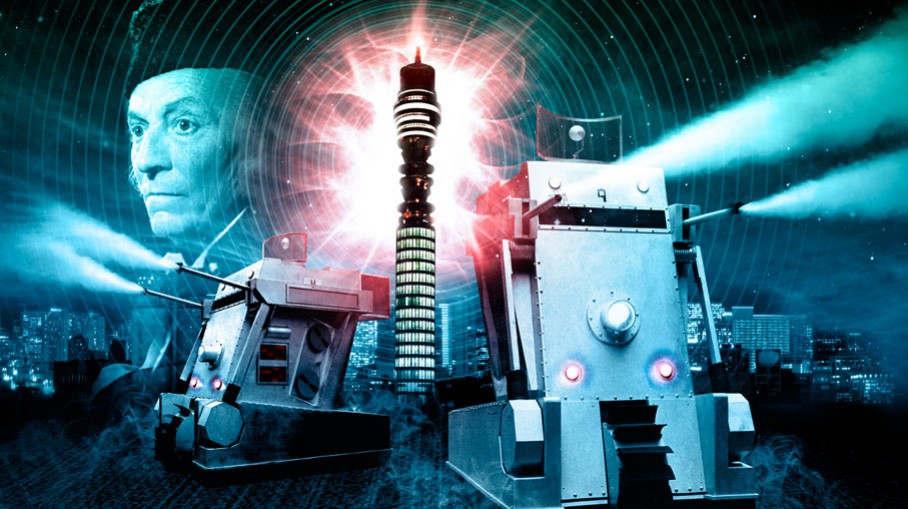
Ben and Polly are introduced in this story and are immediately likeable. The War Machines themselves have bulky designs that don’t look quite that threatening. It is what they DO that makes them formidable, and how the military retreats once the machines have killed a bunch of them, started fires and disabled their weaponry. This is why it’s all the more epic when the Doctor decides not to retreat, and instead walks towards the offending machine. The First Doctor’s standout moment.
After a triumphant defeat, Dodo randomly leaves (seriously, they need to write these companion departures a lot better), and Ben and Polly just stumble into the TARDIS and will surely join the Doctor in the next season.
Oh boy, that was a long one!
And there you have it. What a season it’s been – some of it good, some of it not so good, but ending on a definite high. The same can be said for our leading man William Hartnell, who has more gusto in these last few serials than he had earlier in the season. Doctor Who, like life, is a rollercoaster. Looks like you just gotta ride it.
I’ll see you next time for Season Four.


Comments
No one has left a comment yet.
Be the first and get the conversation going.