

BFI London Report – Special Screening of Galaxy 4
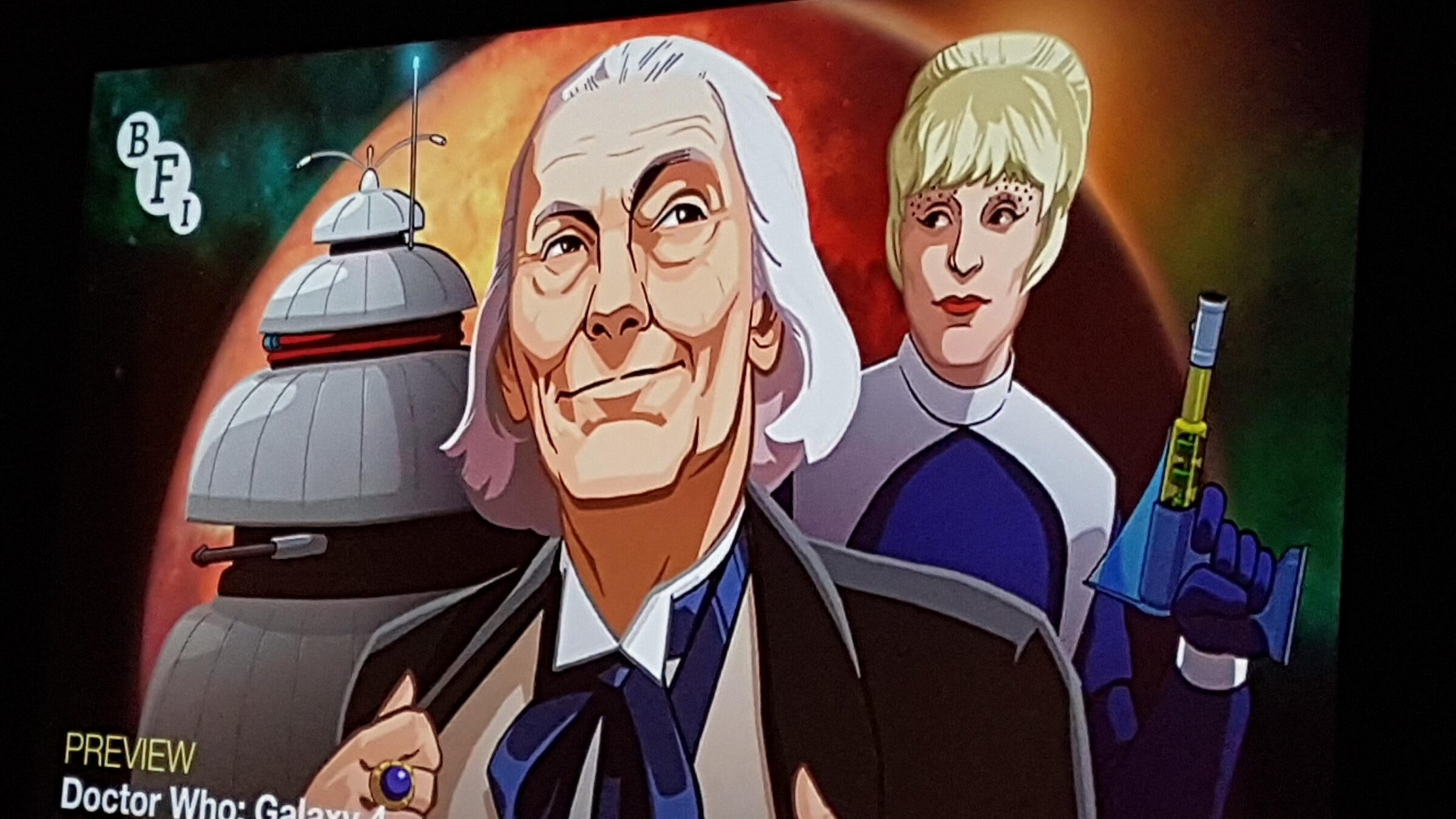
It’s been seven years since any animations were done for the William Hartnell era so news earlier this year in September that a 1st Doctor story was getting an animation makeover was an unexpected but welcome treat. There are still 44 missing episodes from approx. twelve 1st Doctor stories. Perhaps Galaxy 4 is not an obvious story at the top of every fan’s list when thinking of new animations but as was revealed during this event the quality of surviving audio recordings is a factor when discussions about animating stories take place.
So according to my 1989 Doctor Who Programme Guide, the serial known as Galaxy Four (yes I’m a pedant and would have liked to see it spelt out on the DVD cover) or now Galaxy 4, is released on Monday 15th November. To celebrate the BFI (British Film Institute) on the London Southbank ran a screening on the 7th November showing the new animation of this 4-part serial from William Hartnell’s third season.
Justin Johnson (Lead Programmer for BFI) introduced the screening, thanking Russell Minton- Producer and Head of International Production Consultancy at BBC Worldwide for the BBC content they receive for BFI. Due to the speed that the BFI screening information about Galaxy 4 came in September after the screening of the Evil of the Daleks, it was unclear in promotion whether this would be only a screening or if there would be any guests. Much to this audience member delight host Justin Johnson confirmed some unexpected guests as part of the screening as well as a special video introduction from someone unable to be there.
I’m so pleased about this wonderful solution to the lost episodes of Doctor Who and I’m sure you are going to enjoy it very much. I wish I could be with you and I’m really sorry I can’t be
Maureen O Brien, Vicki in Galaxy 4 and eight other stories
Reviewing the Galaxy 4 animation
One of the benefits of the animation medium is there is an opportunity to imagine and immerse your audience with a story set on a different planet that is beyond the budget confines of live studio-based production. An imaginative vista of warm orange, the red, brown colour palette of bright auburn skies looking over three suns and crimson sands wonderfully conveys a planet in the last throes of life.
And that’s not all. Maybe William Hartnell is easier to draw but I was so pleased that the animated facial features of the actors playing Steven, Vicki and the 1st Doctor are recognisably captured in this story, so it didn’t jar for me as with some other adaptions.The animated movements also can look clunky when badly done but thankfully here ( i was watching carefully!) don’t seem as jerky which pleasantly surprised me given the variable results, we’ve had for some of the 2nd Doctor animations.
The Galaxy 4 adaption does lack the sophisticated enhancements of Evil of the Daleks which had hand-drawn 2D characters combined with 3D scenery. Visually it’s less polished in that respect, but it is a competent and easily rewatchable production. Maybe it doesn’t need the additional bells and whistles as the script by William Emms energetically draws you into what is a small-scale battle of ideologies between the Drahvins and the Rills to escape this dying planet. The Doctor and companions are pulled into their drama but at ninety minutes it isn’t a chore to watch and all the regulars get things to investigate or explore.
I really like the way we see the 1st Doctor has to work things out as there’s no sonic screwdriver to just wave about and get quick answers. I do enjoy The Hartnell era because people have conversations, it’s not all quippy language. This script is a“talking” kind of story with bits of action that explores ideas of identity. The actress Stephanie Bidmead who plays Maaga is rather magnificent in her authoritarian way and the “clones “ idea is such a neat sci-fi idea shadowing years ahead of all the things that are becoming science-fact now. The only thing I find slightly jarring is the “booming” voice of the Rills by Robert Cartland which sounds rather theatrical and reminds me in style so much of classic 1960’s Star Trek episodes.
The soundtrack for Galaxy Four is easily dominated by the robot Chumblies and their communication signals which create a musical cue that just sticks in your brain for what seems forever (well it might in mine! ) and you can imagine kids would love imitating. The incidental music is stock instrumental music by Les Structures Sonores but is effective and complementary to the script especially when our Tardis crew first meet the “beautiful” Drahvins.
In memoriam
Before the screening began Justin Johnson spoke about the sad recent death of Bob Baker on the 3rd November. Bob Baker was a classic series writer who had been recording some commentary for content three weeks previous to his death and along with his writing partner Dave Martin in the 1970s co-created one of the most lovable of robot companions K9 The 10th Doctor meets K9 Mark 3 . Bob Baker also had creative input into another canine creation Wallace and Gromit collaborating with animator Nick Park on three separate projects.
Interview with Mark Ayres (Sound Restoration), Ioan Morris (Concept Designer) and Garry Russell (Executive Producer)
Episode 3, “Air Lock”, came back to the archives in 2013 from a former ITV engineer Terry Burnett and there is also some footage from episode 1 used in a documentary in 1977. One of the questions from Justin Johnston to the interviewees was how useful the live footage is for the animation team. As Ioan Morris noted, too much laughter from the audience, there are many scenes throughout Galaxy Four of the robot Chumblies moving and communicating in their beeps, noises, and signals which they wouldn’t want to change. The live episode was useful to the team to be able to see the Drahvins and the Rills spaceships but highlighted the relatively cheap cost of the serial as the backdrop of the Rills ship was made of polyethene.
They decided one of the aims of the animation was to expand the serial with a 2021 treatment keeping the 1960’s feel and being faithful to the original story. Gary Russell’s idea was an emphasis on a pop art feel of lurid colours so there is an Australian Red desert colour for the planet and the colours used “pop”. Some inspiration also came from the original 1960’s Star Trek series and the use of technicolour A different aspect also considered was with live-action the audience is focused on the actors, their body language and eye movements. Animation cannot relay the same aspects but the animation team played with the look of the serial so with the Drahvins making them Amazonian and at 6 foot 5 inches much taller than in real life. The soldiers were also all drawn identically whereas in reality, the actors were obviously not.

What’s in your bag Mark Ayres?
Justin Johnson moved the discussion to ask how decisions are made about which serials to animate as the team had spoken about the colour palette of greens and greys, they used for Fury from the Deep. Mark Ayres discussed this point as he produced from his bag the actual sound tapes from the late Graham Strong. Much of the reason the animations can be done has been purely from the quality of the soundtrack that fans made at home. He mentioned some of the contributors besides Graham Strong who made recordings from the Dalek Masterplan to the Dominators.
There are the Randolph tapes that were rescued from landfill and are recordings from the end of William Hartnell to mid through Patrick Troughton’s era There are also the John Furillo quarter-inch tapes and the David Harman tapes and depending on the best quality (as there can be background noise on tapes ) those will be used. David Harman, who recorded from Marco Polo up to The Three Doctors, was a guest in the audience. He stood up shyly to whoops and cheers from the audience. It was an acknowledgement of the dedication of these early fans whose soundtracks are a surviving record of a pioneering era in early television.
Peter Purves Interview
Peter Purves has been an actor and producer and played popular companion Steven Taylor. He discussed at length his time from 1965 to 1966. One of the unfortunate things is although Steven Taylor appeared in 10 stories (45 episodes) there are only three full stories of his in the archives. Some discussion covered his recollections of The Mythmakers which is completely missing. He also revealed he would really like to see another season three-story The Massacre animated, of which also no footage survives but where he has a central role and William Hartnell plays two roles.
Thoughts on the Galaxy 4 animation – Asked what he thought of his animated figure Peter Purves quipped he didn’t know he was that good! Peter noted he didn’t recognise his voice back then and he thought the production of the animation has been terrific, noting the colouring used and sense of depth created which was very different from the restrictions of a live episode with a painted backdrop.
My word it’s a good’un. It works. It tells the story
Peter Purves about the animation of Galaxy 4
The Galaxy 4 script – Peter Purves historically hasn’t liked the script for Galaxy 4 and discussed what he called a “genuine gripe” at the time about the story. The writer William Emms had written the story originally for Ian and Barbara. Jacqueline Hill (Barbara) was meant to be the main character and the writer was made unaware of the changes of actors until the last minute. Unfortunately, this meant much of Barbara’s dialogue was transferred to Steven. Peter was very angry and had a “flaming row” with producer John Wiles as the heroic, technically very clever young man, described to Peter Purves originally when hired was not there. Unfortunately, he regrets that the writer William Emms also got some of his dissatisfaction although it wasn’t really the writer’s fault.

Starring in The Chase – Peter Purves was invited by Richard Martin to play an American character Morton Dill having been remembered by him following an appearance in a TV Armchair Theatre production. Peter went into rehearsal totally in awe of the other actors and thoroughly enjoyed the whole experience, recording his part in a day. Peter recalled he always got on with “Bill” Hartnell but wasn’t aware at that time how much Hartnell had been terribly upset and worried by the news that William Russell (Ian) and Jacqueline Hill (Barbara) were leaving the show. Maureen O Brien persuaded William Hartnell to speak to Verity Lambert to offer Peter Purves the vacant companion role three weeks later.
Working on Doctor Who- Not gaining acting work afterwards for a long time, due to the part of Steven, meant Peter Purves not really being happy with the role. However, he spoke about how he loved the process of rehearsing and then linear recording an episode. With time always an issue there weren’t opportunities for ad-libbing lines but his experience doing weekly repertory theatre meant he could learn lines quickly. By this point, Peter became aware that William Hartnell was suffering from ill-health but there was still a lot of fun to be had for the actors as “Bill” fluffed his lines.
William Hartnell took time to take Peter under his wing and taught him about creating small gestures for television. Peter discussed humorously at length about working with the director Derek Martinus on Galaxy 4 and the challenges of studio filming when the very technical process of planning and arranging cameras and sound cables didn’t go to plan.
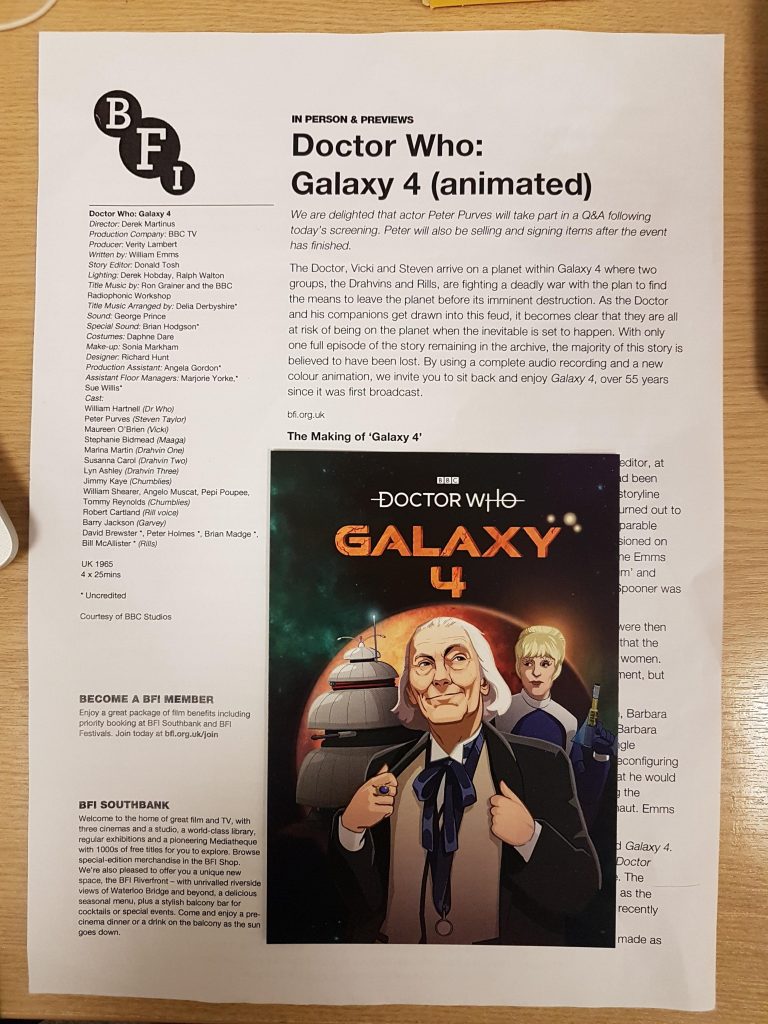
After the interview, Peter Purves stayed for a photo signing and the special BFI / BBC studios postcards were back again marking this new release. As with previous events a long queue formed to meet Peter Purves and share a few words with him before another fantastic BFI event ended. Happy days are here again!
Doctor Who Galaxy 4 was released on Monday 15th November from £14.99 (DVD), £18.99 (Blu-Ray) and Steel book £29.99


Comments
No one has left a comment yet.
Be the first and get the conversation going.