

Midnight – The Genius of Russell T Davis

Previously I wrote an article where I attempted to identify positive aspects of Chris Chibnall’s era of Doctor Who, and the news broke as I was writing that Chibnall and Jodie are set to leave in 2022. Once again, I was in the drafting stage of an article about Russell T Davis’s episode Midnight, and some very topical news came out…
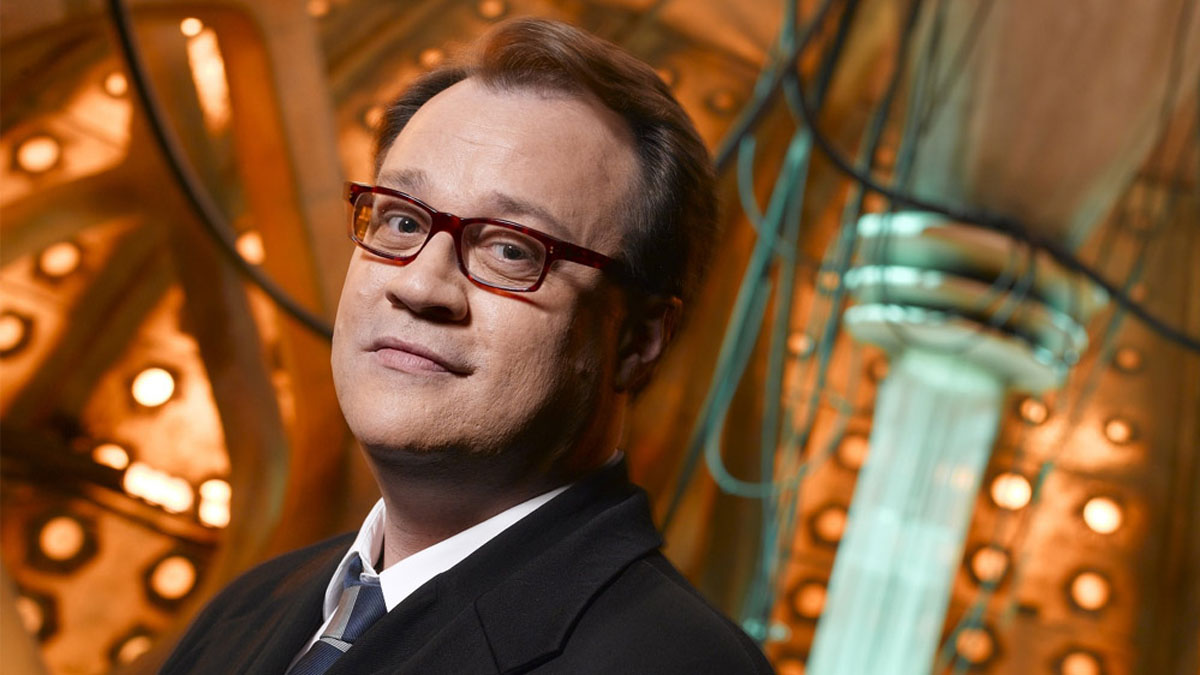
It still has not sunk in that we live in a world where Russell T Davis, the man responsible for the Doctor Who revival in 2005, is coming back. I have a warm fuzzy nostalgic desire to welcome the writer responsible for my being a Who fan back with open arms. This is mixed with an excitement for how he might reinvent the show again or bring back old favourites, like Christmas Specials or spin-off shows. One thing I am certain of though: Russell is the only writer who I would like to have a go at fixing the current issues of the show, and maybe if we are very lucky, bring it into a new set of glory days.
As I reflect on one of my favourite scripts of Russell T Davis, it is clear that our favourite show is in safe hands: those of an experienced Who writer, a master storyteller and an unequivocal genius. Let’s take a look at Midnight.
Scariest episode ever?
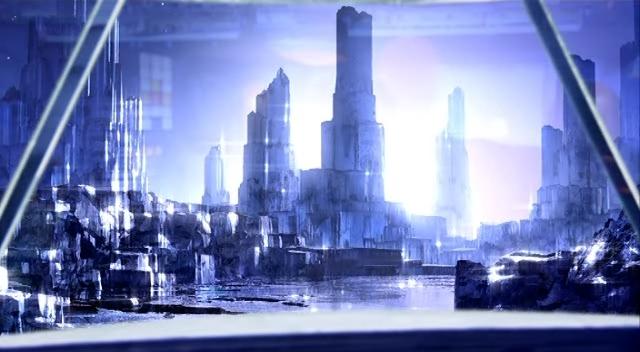
Originally broadcast on 14th June 2008, Midnight is part of the fourth revived series of Doctor Who or the thirtieth season overall. Donna (Catherine Tate) is having a relaxing spa day on the titular planet, while the Doctor (David Tennant) decides to take a tour to a waterfall made of sapphires. It is with the Doctor, his fellow passengers, and the confines of the shuttle heading to the waterfall where the episode is primarily set. The shuttle stops unexpectedly, a knocking can be heard from outside the walls, and an apparent entity from the outside seems to possess Sky, one of the passengers. Quickly, Sky starts to repeat everything everyone is saying, eventually speaking simultaneously with everyone. And if you have seen the episode dear reader – which I am sure you have if you’re reading this – you know all the characters, including the Doctor, are scared out of their wits and have no clue what the heck is going on.
No other episodes of Doctor Who have chilled me to the bone or lingered in my consciousness in a way that Midnight has. I remember the two previous episodes of the run – Steven Moffat’s Silence in the Library & Forest of the Dead – terrifying me as a wee seven-year-old. That story, with its exploitation of fear of the dark and skeletons in spacesuits skulking around, was outwardly scary. It was frightening in a different way to Midnight, which is more implicit in its presentation. The scare factor wasn’t as obvious, so I wasn’t haunted at all by this episode as a child. But like a fine wine, the episode has aged beautifully. And by that, I mean it gets scarier every single time. Today, you would be hard-pressed to find me watching this episode alone on a dark night.
So why is Midnight so exceptionally scary? The first chord struck after Russell begins the episode in his typical light and fluffy way (which he does brilliantly). The Doctor and Donna share some banter, our hero gets complimentary slippers, the passengers are all laughing together, all is fine and dandy. But Russell is secretly lulling the viewer into a false sense of security. The tone shifts once the Doctor enters the cockpit to talk to Driver Joe and Mechanic Claude. While briefly lifting the radiation shields to get a better idea of why the shuttle has stopped, Claude sees something moving. Joe sends a distress call and the Doctor leaves the cockpit. Something just isn’t right.
In the cabin, the Doctor, the passengers and their hostess hear knocking on the walls. Disconcerting, given the ‘something’ Claude spotted moments earlier. And very quickly, the knocking move towards the cowering Sky, the shuttle rocks around violently, and we discover Joe and Claude have been killed, what with the cockpit being ripped apart from the cabin. The script has cruelly taken us from a pleasant day trip and plunged us into an isolated nightmare where the characters are at mercy of a mysterious force that is very powerful and very angry. The only thing preventing pure terror is the sliver of hope that help will come upon hearing Joe’s distress call.
The fact we never see this ‘something’ is a simple but brilliant idea on the part of Russell. Viewers are left to their own imagination to conjure an idea of what this creature is. Any horror fans will know that what isn’t seen is scarier than anything else. In the context of the story, not knowing anything about the antagonistic force outside the shuttle puts our characters at a disadvantage. The characters are so well written and performed that we connect with the situation: we share their sense of fear and powerlessness.
I would like to shout out Alice Troughton’s direction. There is some disturbing imagery in this story. Sky, now taken over by the ‘something’, taking her hands off her head and turning to face everyone, is a proper scary image. Props to the production for realising Sky’s mirroring and copying of everyone else – it must have been difficult to film and edit, but the end result is great. All these elements come together to drip feed the story of the script, giving the audience tiny slices of knowledge without fully revealing the creature’s motive. With this episode, we don’t have the luxury or comfort of being taken fully out of the dark.
Now an invisible enemy stealing voices is bad enough. But things are about to get a lot more pearshaped as the supporting cast begin to turn on our hero, the Doctor.
Breaking Conventions
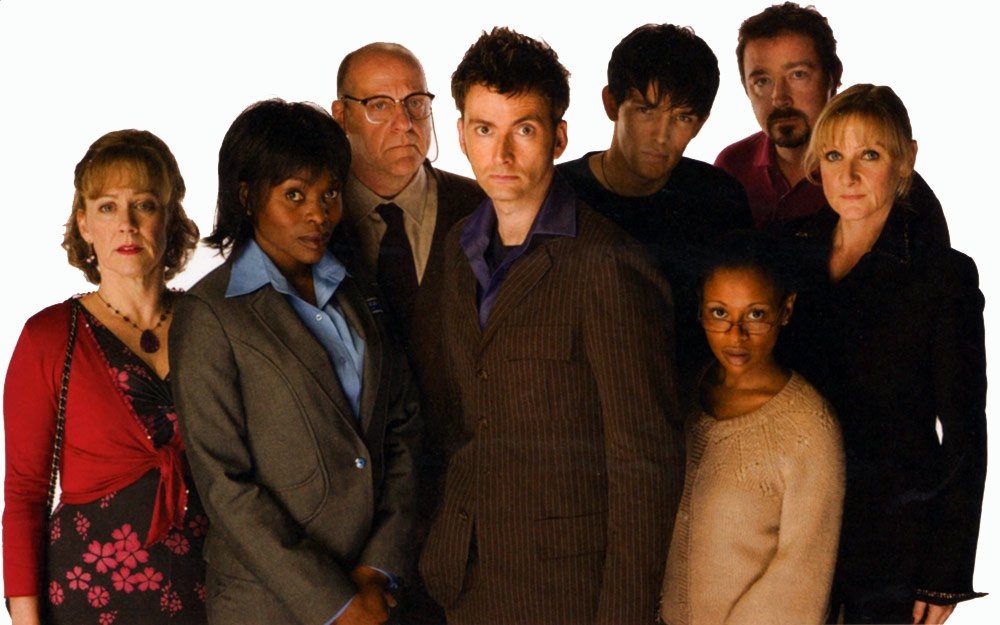
By now, the Doctor is very used to taking charge in situations of crisis. And though the people he meets on his travels sometimes wonder just who the heck put him in charge, generally people follow his lead. Midnight totally kicks this formula in the rear end.
The passengers have a great deal of resistance to the Doctor assuming the highest status. Our frustration as viewers – knowing the Doctor has the best of intentions and is trying to save everyone – comes when they assume the worst of him. The Doctor himself is frustrated because he has become so complacent with people shrugging off his answers to the question ‘Doctor Who, exactly?’. Like scared animals trapped in cages, the Midnight passengers feel threatened by this mysterious figure who claims to be clever and knows what is best for them. The Doctor is just as much an enigma as the beast banging on the walls and making the lady in the corner copy everything they are saying.
To take the caged animal comparison a little bit further, the response these characters have to the situation is rather a primal one. Things start to turn ugly when they lash out at each other – when Biff (the father of Jethro, the husband of Val) tries to make his stamp as the alpha male, or when David Troughton’s Professor Hobbes (who looks so much like his real-life father, Patrick Troughton!) snaps patronisingly at his student Dee Dee. And things get even uglier when we see the unfolding of some of the passengers’ inclinations towards violence.
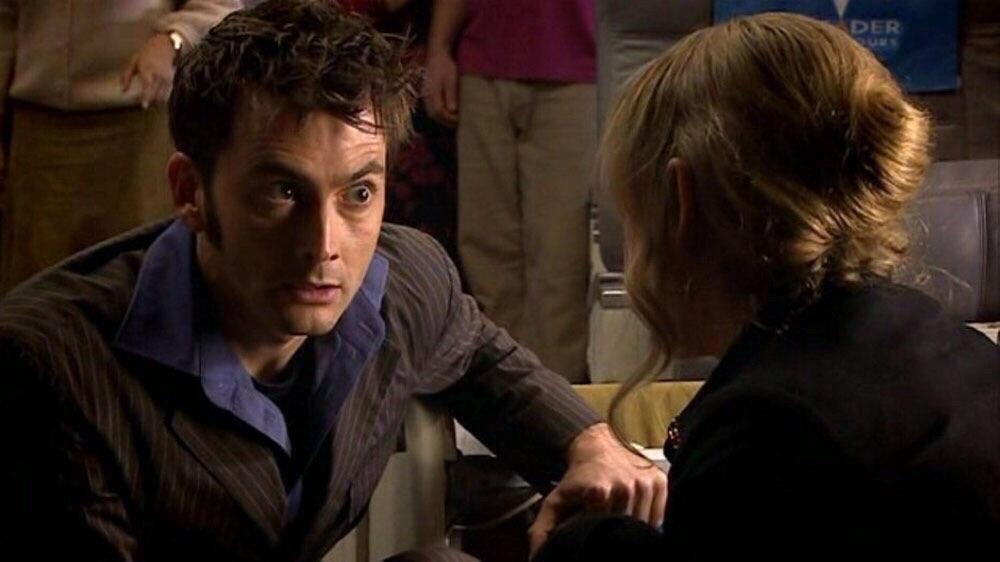
This is all perhaps due to the sheer helplessness of the situation. Indeed, in recent times of crisis and anxiety in the real world, divisions and disagreements have manifested. One might be compassionate towards the passengers losing their composure on this Midnight shuttle – I mean, wouldn’t you if you were in the same scenario? But at the same time, it is harrowing to watch them contemplate murdering Sky, an innocent woman in all this. And it is also disturbing to see them actually ATTEMPT to kill the Doctor when he ultimately gets possessed. The overriding uncomfortable aspect of the episode for me is that it does away with the show’s typical whimsical fun. The so-called good guys are more monstrous than the monster itself, or at least, they are threatening in a more explicit way than the invisible foe. This unique set-up may not be achieved without such dynamic writing, for which we must loudly and proudly accredit Russell T Davies.
Conclusion: A league of its own
Current showrunner Chris Chibnall has not written anything that comes close to the quality of something like Midnight. As a successful writer, he certainly has his strengths, some of which I identified in my article about his era of the show to date. But nothing Doctor Who-related in recent times has come CLOSE to the cultural significance of episodes in the Russell T Davies era. For The Empty Child, it is referred to as ‘the one with the gas mask zombies’. With Blink, people talk about ‘the one with the angels’. When people talk about Midnight, they label it as ‘the one where a creepy possessed person copies everyone’. (these sound like weird ideas for rejected episodes of Friends).
Heck, Midnight was even adapted into a play! You can watch it on Youtube here. This is a credit to the impact that this episode and its script have had.
Chibnall evidently knows to include themes in a script. In my opinion, however, his addressing of subjects is more often than not heavy-handed or too obvious. Since becoming showrunner, this has made a lot of Doctor Who in recent memory feel more preoccupied with preaching particular messages than telling all-around good stories. It doesn’t help that the characterisation in these last few seasons has been weaker, highlighting this apparent importance on allegory even more. Seemingly, spending each week shouting about a different issue in the world today is trading off complex and compelling narratives and players within them.
Truthfully, I think Doctor Who has always been choc-full of themes – political, social or otherwise. Storytelling in general is. Regarding Who, I reckon we have never thought about it before because it has always been done more dynamically. In Russell T Davies’s era, we have more complex characters (I could gush about these all day long – maybe that could be a future article) and more complex narratives. Namely, Midnight is an episode dealing with such meaty themes – the lengths we will go to deal with a crisis or find order in chaos – dressed up as a thrilling instalment in a Saturday dinnertime adventure show. One surely cannot think of this story at face value as a display of the uglier side of the human condition. On the other hand, Orphan 55 of the Chibnall era is viewed as such – the climate change-focused episode – and nothing more than that. To unlock the thematic elements of Midnight, audiences must dig a little deeper. It is after mulling over the events of this episode over many years that I have started to appreciate its complexity. It is one reason that thoughts about what Russell might write for his second go at Doctor Who are so tantalising.
Moreover (though this isn’t necessarily a requirement), Midnight is universal in its subject matter. It makes use of something that is common in every human experience, by virtue of the fact that our origins and life after death are a mystery to us all. In this little base-under-siege horror of an unknown threat lurking in the dark, master storyteller Russell T Davies taps into a fear that plagues us all: the fear of uncertainty.
But anyway… don’t let that get ya down. Have another look at this funny preview of what is essentially the first-ever Doctor Who Halloween Special! ‘How old are you?!?!’
Happy Halloween, Who fans.


Comments
No one has left a comment yet.
Be the first and get the conversation going.